Thursday, February 11, 2021

China Denies COVID Came From Wuhan


The Chinese government has been fervently denying accusations that the COVID-19 virus originated in Wuhan China. If one were to believe what the Chinese media has been publishing, it would be likely that they would assume that the World Health Organization (WHO) agrees with the Chinese government on how the virus developed and spread. This is not the case. A four-week investigation was launched by The WHO: they studied the length of time that infections began to spread in Wuhan, how the city had handled sanitary measures, and how they were able to return to a normal life after a long lockdown process. It was reported that when the WHO sent their team in, the Chinese government provided them access to everything that they requested. This came as a surprise, it was expected that China would have wanted to be more secretive about how they mishandled COVID in the beginning. 

(within hours of the lockdown being lifted, 65,000 people fled Wuhan)


The Chinese media have used statements from The WHO in order to spin the narrative in their favor. They have taken an innocent until proven guilty approach and because the investigation did not bring about any significant findings, the Chinese are holding onto their innocence. The mishandling of the virus has caused a rift in relations between nations. China feels like they are being blamed for the entire spread of the virus: they do not think that they deserve all of the blame as they are holding onto the claim that it did not originate in Wuhan. This criticism has been around since the beginning when China neglected to inform the WHO about a pneumonia-like illness that began to circulate in late 2019. The Chinese National Health Commission (CNHC) told reporters that they do not know how the virus traveled to the Huanan Seafood Market in Wuhan. Contaminated products frozen foods, animals, and infected humans have been cited as possible sources of the outbreak. 

                                     (Medical workers transfer a body through the city of Wuhan)

The WHO also addressed two other origin stories for COVID-19. They did not rule out the possibility that the virus escaped from a lab in Wuhan. China has been pushing the frozen food theory. They believed that the grocery supply chain brought the virus into Wuhan from another country. Scientists from across the world have ruled this out as a possibility. The US Centers for Disease Control (CDC) is firm in its belief that there is no way that it would be possible for the virus to transfer in the way that the Chinese government is claiming. For months, China’s propaganda has been attempting to reverse its image as the origin point of the global pandemic. Along with Chinese politicians, the Chinese Centers for Disease Control have also tried to push a baseless theory that the virus was created in a US lab; but, like many other theories, it has been shut down swiftly.


Sources:

https://economictimes.indiatimes.com/news/defence/us-army-brought-coronavirus-epidemic-to-wuhan-chinese-diplomat/articleshow/74607344.cms?from=mdr

https://www.nbcnews.com/news/world/who-s-covid-mission-china-give-first-report-n1257105


https://www.cnn.com/2021/02/10/asia/who-china-coronavirus-intl-hnk/index.html


https://www.aljazeera.com/news/2020/4/8/chinas-wuhan-ends-coronavirus-lockdown-but-concerns-remain


https://www.voanews.com/science-health/coronavirus-outbreak/china-didnt-warn-public-likely-pandemic-6-key-days


The Deadly Consequences of Colombia's Failed Promises

Over the last four years, hundreds of Colombian activists have been murdered. According to the UN, approximately 120 defenders of human rights were killed in 2019 alone (Hurtado, 2020). These activists do not belong to one group or organization, but they fight for the rights and protections of a diverse group of Colombians in rural areas, some focusing on Indigenous freedoms, and others on the rights of Colombian women and gender minorities (Pappier and Villarreal, 2021).

But why are these people, many of whom peacefully advocate for minoritized groups, being murdered at the highest rates in Latin America? (Pappier and Villarreal, 2021) This violence has a long history in Colombia, but this particular phenomenon has been precipitated by governmental failures since 2016. Specifically, the Colombian government signed a peace deal with the guerilla group Revolutionary Armed Forces of Colombia (Fuerzas Armadas Revolucionarias de Colombia, or FARC for short) in November of 2016 (Pappier and Villarreal, 2021). While this peace deal was intended to stop decades of conflict, demobilize the group, and stop the killings of human rights activists, some former FARC members have given up on peace and other, newly violent groups have stepped into the vacuum left by FARC’s dissolution (Garcia Cano, 2021).

The Colombian Flag of Peace

The Colombian Flag of Peace

Ultimately, however, this is not the fault of one individual or even one group; it is the failure of the Colombian government which has had such deadly consequences. Of the approximately 120 killings in 2019, the United Nations has reported that “the great majority… happened in rural areas,” with 86% of the murders occurring in impoverished villages (Hurtado, 2020). In addition to the stereotypical, international neglect of rural communities by their governments, these killings represent the violent consequences of both a sub-par judicial system and of rights disparities. In this case, the former in particular has contributed to the “limited government efforts to undermine armed groups’ power” (Pappier and Villarreal, 2021). In other words, those who have murdered prominent human rights activists have not been consistently brought to justice for their crimes. Those who opposed human rights activists were not only given leeway by the Colombian government, but they were brought to violence first by their lack of access to public services. Contrary to the promises made in their 2016 peace agreement with FARC, the Colombian government did not ensure that people in rural communities received an education, had opportunities for economic stability, and more (Pappier and Villarreal, 2021).


Iván Duque Márquez, the current President of Colombia

As a result of these killings, Colombia has joined Iraq and the Philippines in the top three countries with the most activists murdered (Garcia Cano, 2021). The Human Rights Watch has recently advised that the United States and European Union assist the Colombian government in addressing this serious human rights violation, by “press[ing] Colombian authorities to… overhaul existing" protections of human rights activists and “exploring new avenues to reduce the power and corrupt influence of armed groups” (Pappier and Villarreal, 2021). While the Human Rights Watch also includes more specific instructions regarding Colombian drug production, these demands of the United States government in particular are vague and unfortunately ironic. With an attack on the United States Capitol building cemented in American history just over a month ago, the “influence of armed groups” is not a problem exclusive to Colombia; rather, it is a problem in the very countries being called upon to assist Colombia (Pappier and Villarreal, 2021). And, with the increase in Black Lives Matter protests (globally and in the United States) in the summer of 2020, the United States exhibited institutional violence against human rights protesters. The causes of these issues might appear disparate, but the result remains the same; activists’ safety is threatened in all corners of the globe, and requires more than “exploring new avenues to reduce the power… of armed groups” (Pappier and Villarreal, 2021). Globally, we need institutions to change and equitably promote education, economic stability, and human rights for all. As the spokesperson for the UN High Commission for Human Rights, Marta Hurtado, stated in regard to the Colombian murders, “any attack against human rights defenders… constitutes an assault against democracy” (Hurtado, 2020).

Sources:

Garcia Cano, R. (2021, Feb 10). Report: Colombia failing to protect human rights defenders. ABCNews. https://abcnews.go.com/International/wireStory/report-colombia-failing-protect-human-rights-defenders-75793952

Hurtado, M. (2020, Jan 14). Colombia: Human rights activists killings. United Nations Human Rights Office of the High Commission. https://www.ohchr.org/en/NewsEvents/Pages/DisplayNews.aspx?NewsID=25461&LangID=E

Pappier, J. and N.C. Villarreal. (2021, Feb 10). Left Undefended: Killings of Rights Defenders in Colombia's Remote Communities. Human Rights Watch. https://www.hrw.org/report/2021/02/10/left-undefended/killings-rights-defenders-colombias-remote-communities

Images:

The Peace Flag. (2013, Sept 21). https://upload.wikimedia.org/wikipedia/commons/1/1a/Colombian_Flag_of_Peace.jpg

U.S. Department of State. (2020, Sept 19). Secretary Pompeo Delivers a Press Statement with Colombian President Duque. https://upload.wikimedia.org/wikipedia/commons/d/d7/Secretary_Pompeo_Delivers_a_Press_Statement_with_Colombian_President_Duque_%2850369491081%29_%28cropped%29.jpg

Wednesday, February 10, 2021

Russia: A Global Model for Authoritarianism?

Since the conception of institutions like the United Nations Development Program (UNDP), the United States has arguably been developing a campaign to spread democratic values across the globe. The UNDP highlights three overall goals for democracy and governance: 1) fostering inclusive participation, 2) strengthening responsive governing institutions, and 3) basing democratic governance on international principles (Human Development Reports). The United States Agency for International Development (USAID) also places a priority on promoting democratic transition and governance in accordance with foreign policy objectives. Because of programs such as these, each year we’ve continually seen steps towards the world becoming increasingly democratic, until recently. My argument is that developing countries that once looked to the United States as a model for governance are now looking to other nations, primarily Russia, as skepticism has increased over the success and stability of the American political system. I think that not only is democracy being threatened on a domestic front in the U.S, but also externally as countries like Russia continue to gain influence in the political sphere with a coercive model of organization. 


Dmitry Medvedev, former Russian President and current deputy chairman of Russia’s Security Council in a recent interview with Interfax, a privately-held independent news agency in Moscow, stated that Russia is “legally and technologically ready to disconnect from the global internet if needed” (The Moscow Times). In November of 2019, the state passed a “sovereign internet law” which gives it the ability to pull its servers from the World Wide Web (Epifanova). This statement was given during the wake of the protests incited by the detention of out-spoken Putin critic Alexei Navalny in late January 2021. A few weeks later, Myanmar's military rulers shut down the country's internet in reaction to the thousands of people protesting against the military coup on February 1st (Myanmar coup BBC). Within the next few days, the Indian government and the Modi administration chose to suspend their internet connection in order to prevent the farmers’ protests from affecting social stability (Hollingsworth). The internet shutdown in these countries shows a regression in the United States’ mission to institute democratic values. Specifically in the country of Myanmar, where a flourishing democratic system started to develop which even culminated in a landslide victory for the National League for Democracy (NLD) party in 2020.


The crackdown on protesters both politically and physically indicates that these regimes are relying more on authoritarian tactics to protect against a possible threat to power. I believe that Putin intends to increase the authoritative measures that he uses to protect his power and the implementation of the “sovereign internet law” will limit the exposure of his activity that would otherwise attract attention and possible intervention from other nations. In addition to this, my argument is that by doing so Russia is setting an example for other countries in the region who are experiencing similar political issues. Whereas before these same countries may have looked to the U.S for political organization, I’m convinced now that Russia's model for political organization is becoming more attractive in the eyes of these developing Asian nations.


Sources:


Epifanova, A., & Officer, A. . Deciphering Russia's "SOVEREIGN Internet Law". https://dgap.org/en/research/publications/deciphering-russias-sovereign-internet-law


Hollingsworth, J. (2021, February 03). India cuts internet around New Delhi as protesting FARMERS clash with police.

https://www.cnn.com/2021/02/01/asia/india-internet-cut-farmers-intl-hnk/index.html


Human development reports. http://hdr.undp.org/en/humandev


The Moscow Times. (2021, February 11). Russia is 'ready' to disconnect from global internet, MEDVEDEV SAYS. https://www.themoscowtimes.com/2021/02/01/russia-is-ready-to-disconnect-from-global-internet-medvedev-says-a72791


Myanmar coup: Internet shutdown as crowds protest against military. (2021, February 06). https://www.bbc.com/news/world-asia-55960284


Troianovski, A., Nechepurenko, I., Kramer, A., & Higgins, A. (2021, January 31). Navalny protests live UPDATES: Russians Defy Kremlin in Nationwide Demonstrations. https://www.nytimes.com/2021/01/31/world/europe/russia-protests-navalny-live-updates.html


Haiti's devolution from democracy to dictatorship

Akil Smart


    After years of hardships suffered under the hands of a series of unforgiving and corrupt presidents, Haiti's democracy has come to the brink. On February 7, 2021, the current sitting president, Jovenel Moïse, refused to step down from his office. His reasoning for not doing so was that an interim government had occupied the first year of his presidency, meaning his term would end on February 7 of the next year. This resulted from the 2016 elections being fraudulent and was intended to not leave a power vacuum in Haiti until a proper election could be held. 

President Jovenel Moïse’s term ends on Sunday, but he is refusing to vacate the office before February 2022.

President Jovenel Moïse

    This revelation provoked an immediate response from the opposition, who refuted this claim and called for President Moïse's resignation. Sunday following his announcement, protests, and clashes with the police had already begun, leading to many demonstrators' arrests. Amidst the chaos, the government announced that it had arrested 20 people believed to be involved in a coup attempt. Each of the figures arrested was prominent, including a supreme court judge and Haiti’s police general inspectors. Before these arrests, in an hour-long speech, the President stated, "I am not a dictator," in an attempt to reassure the people.


    While President Moïse's supporters may have been reassured by this, it seems that the evidence is ever-increasing against him. Since his term began, Moïse has suspended two-thirds of the senate, the entirety of the lower Chamber of Deputies, and stripped the power of every single mayor in the country. This has left only eleven elected officials representing a country of over eleven million and the President ruling by presidential decree for nearly a year, refusing to hold any elections. The United States government has also been able to tie criminal attacks on the president's opposition back to high-ranking officials in the Haitian government. With President Moïse's refusal to step down, it may mean a dark future for democracy in Haiti.


Police move detained demonstrators in Port-au-Prince, Haiti, on Sunday.

Police move detained demonstrators in Port-au-Prince, Haiti, on Sunday.

As tensions rise, many Haitians are fearful of what the future holds. Although the Haitian judiciary branch has ruled in favor of the opposition, deeming that Moïse's term was up on Sunday and the opposition choosing an interim leader, the people remain unsafe and unsure. Haiti's opposition party is currently not strong enough to form its own government, leaving no real challengers to the president's rule. The people, having faced an ongoing Kidnapping and ransom epidemic, covid-19 and over half of the country living in poverty, have begun to flee or fight. Many have begun to shelter in out of fear, while the opposition hopes to incite further demonstrations against the President. Many have begun to seek asylum in the United States due to the ongoing crisis but have been turned away. As the situation continues to worsen, it is probable that more will continue to run in search of asylum. 

    Haiti's current predicament may be the begging of the downfall of democracy in the country. As President Moïse leans further and further towards authoritarianism with no one to oppose his rule, Haiti's future remains uncertain. The people of Haiti will continue to struggle, hoping for an end to this nightmare.

References:

Board, E. (2021, February 10). Opinion | Haitians are fleeing their country. their president is the source of the problem. Retrieved February 11, 2021, from https://www.washingtonpost.com/opinions/global-opinions/haiti-jovenel-moise-dictator-immigration/2021/02/10/67fb4b06-6a53-11eb-9ead-673168d5b874_story.html 

Hu, C. (2021, February 08). Haiti's government claims it Stopped coup Amid dispute over presidential term limit. Retrieved February 11, 2021, from https://edition.cnn.com/2021/02/07/americas/haiti-president-jovenel-moise-term-protests-intl/index.html

ICE defies Biden and Deports CHILD asylum seekers to Haiti as it faces political chaos. (2021, February 09). Retrieved February 11, 2021, from https://www.independent.co.uk/news/world/americas/us-politics/biden-ice-haiti-children-deportation-b1799788.html

Isaac, H., Paultre, A., & Abi-habib, M. (2021, February 07). Haiti braces for unrest as president refuses to step down. Retrieved February 11, 2021, from https://www.nytimes.com/2021/02/07/world/americas/haiti-protests-President-Jovenel-Mois.html


China's Attacks on Democracy

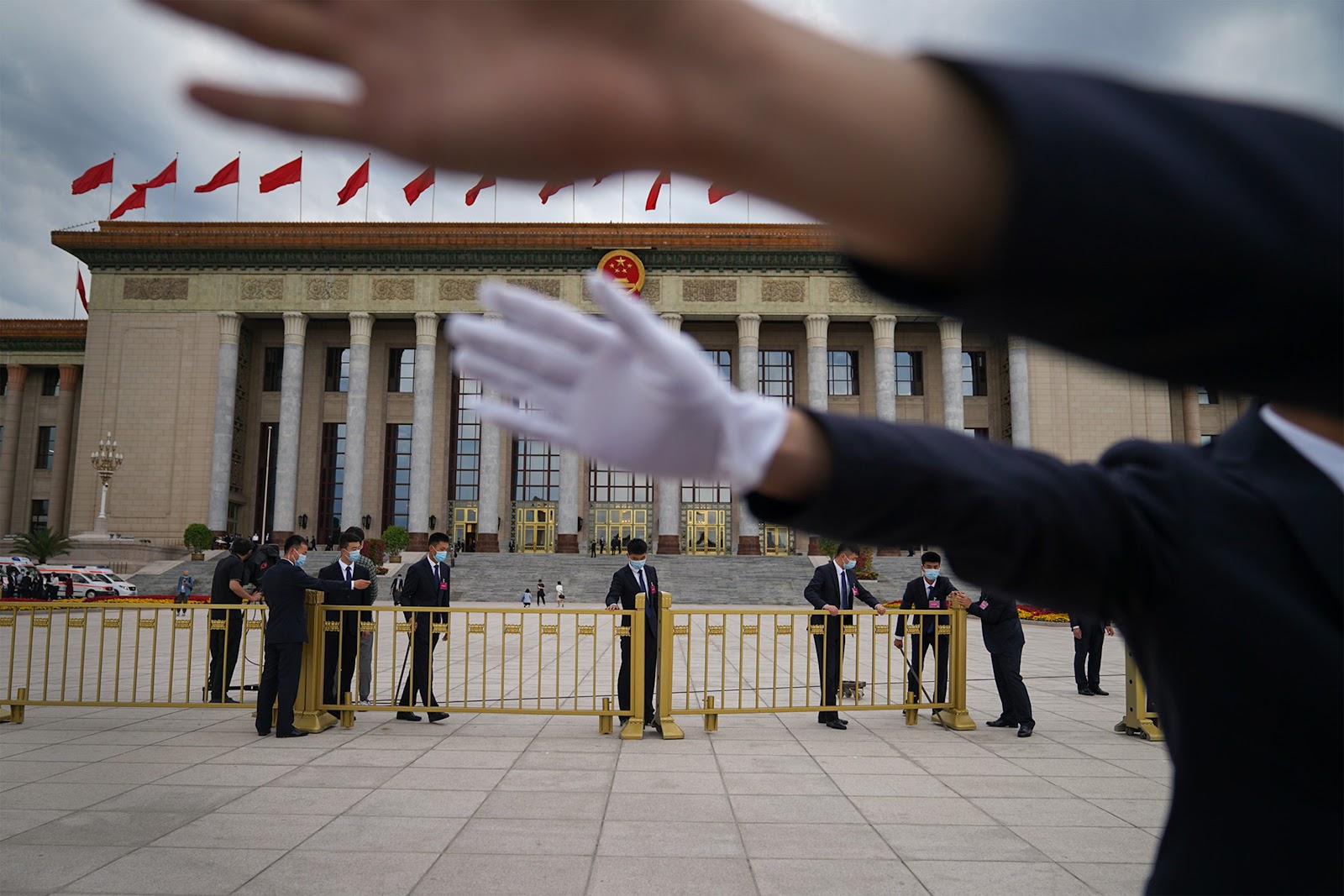
While some countries favor a democratic system of ruling, other countries may take a more authoritarian approach. While we generally consider the latter to be detrimental to basic democratic principles and personal autonomy, few countries have taken such a drastic approach to undermine and eliminate democracy as China. Through numerous different approaches, the Chinese government has eradicated democratic behavior to ensure that the Chinese Communist Party (CCP) remains in total control. 


The Chinese Communist Party has been the dominant party and political ideology since the People's Republic of China was first established in 1949 by Mao Zedong. The CCP has remained the dominant party, not by happenstance, but because of intentional efforts to eradicate any semblance of democracy. The first way in which democracy and autonomy have been stripped from Chinese citizens is through their election process. Chinese presidents and other important leaders do not come to power through national elections. Rather, they are elected by the Central Committee, made up of elected delegates from the Communist Party of China (CPC). This allows the decision-making power to remain within the CCP and ensure that the Chinese Communist Party continues to rule China. At the local level, Chinese citizens are able to elect officials democratically. While this appears to afford Chinese citizens direct participation in their government, it only serves to create a false sense of autonomy and individualism so that citizens will not question their lack of influence at the national level. 


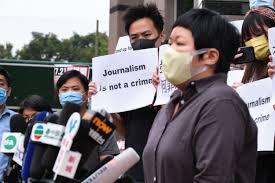
The second way in which the Chinese government prevents democracy is through their control of the media, which further allows them to safeguard the CCP's rule. Despite having a Chinese constitution that grants citizens freedom of speech and press, the Chinese government censors and regulates the media, claiming that certain information endangers the country by exposing state secrets. Anything that the Chinese government believes could threaten their legitimacy is banned under the pretense that it is in order to protect national security. Other media censorship includes the Great Firewall, which bans certain websites, apps (social media, games, etc.), as well as jailing journalists and citizens who openly oppose the communist narrative presented by the CCP. Media censorship in China is a particularly potent threat to democracy as it prevents any access to opposing views and destroys the ability to think freely.              


Even more concerning than China’s more obvious attacks on democracy are the consequences for being perceived as dissenting by the Chinese government. Claiming a preemptive "re-education" for "potential terrorists," the Chinese government has imprisoned over a million Uyghurs, china's mostly Muslim minority, as well as other ethnic and religious minorities and those who vocalize their opposition to the CPC. Uyghur people are abducted from their homes and sent to concentration camps to be forcibly indoctrinated by Communist sentiment. While the Chinese government claims that this is being done to protect national security and reduce threats of terrorism, many others have likened it to a modern-day holocaust. Not only has this practice further eradicated any hope for democracy, but it has also violated the most basic and fundamental human rights. 


Ultimately, the Chinese election process, media censorship, and concentration camps are all ways in which the Communist Party of China dismantles systems of democracy in order to protect its position as the dominant party. The Chinese government has deliberately eliminated any democratic behavior in order to ensure that the Chinese Communist Party remains in total control. If continued to be left unchecked, these attacks on democracy will surely spread internationally to other countries not strong enough to challenge the rule of the CCP.


https://www.cfr.org/backgrounder/media-censorship-china


Resources:


Rogin. 2019. "China's efforts to undermine democracy are expanding worldwide."

    https://www.washingtonpost.com/opinions/2019/06/27/chinas-efforts-undermine-democracy-are-      

    expanding-worldwide/ (Accessed Feb 10,2021).


Britannica, T. Editors of Encyclopedia. 2016, July 18. "Chinese Communist Party." 

    https://www.britannica.com/topic/Chinese-Communist-Party (Accessed Feb 10, 2021). 


BBC. 2017, October 6. "Communist Party Congress: How China picks its leaders." 

    https://www.bbc.com/news/world-asia-china-41250273 (Accessed Feb 10,2021).


Bell. 2015, May 29. "Chinese Democracy Isn't Inevitable." 

    https://www.theatlantic.com/international/archive/2015/05/chinese-democracy-isnt-inevitable/394325/        (Accessed Feb 10, 2021). 


Thayer. 2019. "Celebrating tyranny: The People's Republic of China turns 70." 

    https://thehill.com/opinion/civil-rights/463588-celebrating-tyranny-the-peoples-republic-of-china-turns-

    70?rl=1 (Accessed Feb 10, 2021). 

Tuesday, February 09, 2021

Murky Clouds Obscure the Sum: Thailand targets protesters in massive dragnet

Began since last spring, Thailand has suffered one of the most serious political unrest on its history. Though this movement that leads by students and young elites cause massive influence and attention in world, Thailand political situation has not been improved until today. The action and call out protesters have made are very likely lead to nothing but long term prisons. 

The immediate cause of the revolution is on last spring when some high school students pushing for changes to school uniform rules, then expanded to the call of searching various dissidents who have disappeared while in exile overseas. The reason that stands behind is the unlimited power of the royal and the autocratic rule by the military government.


According to The New York Times, by the summer the protesters, who gathered every few days despite fears of an army crackdown, were calling for the resignation of Mr. Prayuth, a former general who led a 2014 coup, and for the monarchy to come under the Constitution. However, their demands have not been met, nor are they likely to be taken seriously by the political establishment. Mr. Prayuth is still in charge. The king continues to stay above the laws.

Now the Thailand government starts their massive retaliatory actions toward protesters. An actress stands accused of breaking the law by cheering on and delivering food to hungry members of the protest movement. A woman who is accused for insulting the monarchy was sentenced in January to 43 years in prison. In fact, some young protesters have as many charges laid against them as years they have been alive, 

So what we get? Despite to admire and salute the courage protesters have demonstrated, we have to sadly acknowledge their actions haven’t made big enough change to this country. In fact, in recent years the civil disobedience and protest have successfully rise in various states, including the newest one in Myanmar. However, none of them get success or achieve the goal that they established at beginning. As a Southeast Asia country that is similar to Thailand in many ways (military regime, long time authorized rule, and strong conservative tradition in religion), Myanmar’s revolt is very likely get a similar result. 

The fundamental reason behind these tragedies is the extreme imbalance between the force of protesters and government. Controlling the army that can easily turn guns against their own people, the legislative/judicatory branch that serve for the executive and sometimes even the media both in tradition and in internet(by simply ban those media accounts). While for the protesters, to organize a large scale assemble and maintain the peace inside is already difficult. Except umbrellas, their weapons usually only left constitutions that lack of constraining force. 

In conclusion, countries like Thailand and Myanmar has been suffered for the issue of democracy in decades. Locate at a relatively not that attention area, the pro democratic protest and revolution become even more difficult to achieve. Now the movements in these regions are like suns that have been obscured by murky clouds. However, just like that cloudy sky, these protests and movements are also the sign of a heavier storm and it is reasonable to believe that the high pressure policy authoritarian apply will automatically leads to the storm. Sun can be obscured for awhile, but finally it shall appears on the sky again and  spread light to all. 


Reference: Thailand Targets Pro-Democracy Protesters in Sweeping Legal Dragnet, Hannah Beech and 


Monday, February 08, 2021

Myanmar Military Coup: What It Means For Neighboring China's Aspirations

    Nick Johnston

    On February 1st, 2021, the Myanmar military overthrew the sitting government and seized control of governing power. The coup followed a landslide election victory for pro-democracy candidate Aung San Suu Kyi and preceded the opening of the new parliament (Cuddy). She and other (previously) elected officials are currently under house arrest while General Min Aung Hlaing has taken the reins. The events fomented domestic unrest, as mass pro-democracy protests have erupted throughout the country. The political and social instability spells trouble for not only the legitimacy of Myanmar as a state, but also for other countries in the region. China, a growing superpower, stands the most to lose bearing further complications of its South-Western neighbor.

                           Fitness instructor unknowingly records military coup during workout
                           Photo via: Global News Trending Twitter, globalnews.ca

    In recent years, China has taken aggressive actions to expand its authority. The country's desire to extend economic and military power throughout southeastern Asia has heightened tensions, most notably in the South China Sea. Authority over the ocean beyond territorial waters is highly contentious, and China constantly looks to gain a stronger foothold to strengthen maritime power. The Chinese do this with show of force and innovative actions. During the past decade, China began building artificial islands in the South China Sea (Panda). These islands are used not only for military purposes, but to strengthen claims over the surrounding water. While seeking to expand influence, China constantly antagonizes states in the region. 
    
    China's aggressiveness is a growing trend. In late January, 2021, China breached Taiwanese airspace with 13 warplanes (Connelly). This action follows years of growing anxiety that China might one day invade Taiwan. Newly confirmed U.S Secretary of State Tony Blinken released a statement supporting Taiwan sovereignty, saying "the commitment to Taiwan is something that we hold to very strongly... part of that commitment is making sure that Taiwan has the ability to defend itself against aggression" (Connelly). His comments show the severity of the situation; China's increasingly ambitious attitude is gaining worldwide attention.

So what does this have to do with Myanmar?

                               Pictured: The China-Myanmar Economic Corridor
                                Via: MyanmarTimes, Feb 1, 2019.

    The answer to this question becomes quite clear when viewing the image shown above. Pictured is the provisional route of railways and port projects that run from South-western China through Myanmar to the Bay of Bengal. This project is an extension of China's "Belt and Road" program, seeking to expand economic access to the Indian Ocean (Kondepudi). There is a new problem with this venture; it was agreed upon by (newly incarcerated) Aung San Suu Kyi in early 2020. Xi Jinping reportedly forged a close ally in Kyi. It is unclear whether the new leadership will take kindly to China's aspirations. Chinese state media, Xinhua, seems to be treading lightly, using rhetorical techniques to avoid belligerence with new commander-in-chief Hlaing. The state media outlet referred to the coup as a "major cabinet reshuffle" (Kondepudi). The country has yet to condemn the coup. Xi Jinping desires the domestic and political stability of Myanmar in order to continue China's pursuit of economic maritime power through Myanmar. The coup throws a wrench into the works.


References:

Connelly, E. (2021). China sends warplanes into Taiwan’s airspace: report. New York Post. Retrieved 9 February 2021, from https://nypost.com/2021/01/23/china-sends-warplanes-into-taiwans-airspace-report/.


Cuddy, A. (2021). Myanmar coup: What is happening and why?. BBC News. Retrieved 9 February 2021, from https://www.bbc.com/news/world-asia-55902070.


Kondepudi, R. (2021). In geopolitical struggle over Myanmar, China has an edge. MSN. Retrieved 9 February 2021, from https://www.msn.com/en-in/money/topstories/in-geopolitical-struggle-over-myanmar-china-has-an-edge/ar-BB1drgnb.


Panda, A. (2021). Are China’s South China Sea Artificial Islands Militarily Significant and Useful?. Thediplomat.com. Retrieved 9 February 2021, from https://thediplomat.com/2020/01/are-chinas-south-china-sea-artificial-islands-militarily-significant-and-useful/.


Russia: A Continuation to Undermine Democracy
By Alec
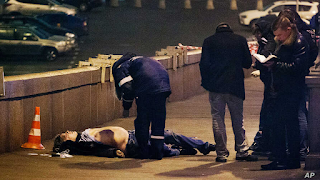
Over the past decade, the Russian Federation has cracked down on the human rights of its citizens in an effort to maintain power. For example, Russia has killed countless journalists who have either written critically of Russian President Vladimir Putin or who have openly questioned the Russian Federation’s government. For example, journalist Boris Nemtsov was gunned down in the shadow of the Kremlin. Another example of Russia’s violation of rights are the oppression of religious and ethnic minorities. For instance, Russia’s Checnynan population is blamed oftentimes without evidence for terrorist activities in Russia.
The most threatening actions the Russian Federation has taken are the attempted interference in United States elections. Putin earned international attention, in particular, for Russian attempted interference in the 2016 Presidential election. Russian hackers released information -- some of it factual and some of it false -- about Democratic Presidential candidate Hillary Clinton. The goal of Putin was to have Republican Presidential candidate Donald Trump win the election because he felt Trump would be less harsh on Russia than the Obama Administration.


There is a lot of discussion as to how the new administration is going to handle Putin and his attempts to seize more power. The conflict between Russia and America is not as simplified as it was during the Cold War: Capitalism vs Communism and good vs evil. Russia and America do have common interests in stopping terrorism and maintaining peace in the Middle East. However, an administration cannot give Putin too much leeway for Russia to expand its influence in countries such as Ukraine like the Obama Administration. However, an administration cannot openly turn a blind eye to the attacks on Democracy, which Trump repeatedly did. Biden must be on alert for Russia to undermine democracy given how they have destroyed the post Soviet democratic state.


https://time.com/5565991/russia-influence-2016-election/
https://www.mccaininstitute.org/working-group-making-the-case-for-human-rights-in-russia/
https://www.dw.com/en/boris-nemtsov-the-man-who-dared-to-criticize-vladimir-putin/a-52561085


Myanmar Coup: How Free are the People?

 The context for Myanmar Government

The country of Myanmar was once ruled by Britain and did not gain freedom until 1948. Although the new country was free, they still barred certain people from holding rights due to being part of minority groups. After a military coup that formed a military social democracy from 1962 to 2008, the country held its first election that would approve the constitution. The constitution would split the government from social democracy to a democratic government with a judicial, legislative, and executive branch (Pariona). In 2016, the National League for Democracy (NLD) won the election and appointed U Htin Kyaw as the new president of Myanmar. He took the spot from Aung San Suu Kyi, an “icon for democracy” who has been barred from holding presidential power in government because of her power against the government's militaristic regime (Rieffel).  

Image result for myanmar government

POOL New / Reuters


2021 Coup

On February 1st, many members of the NLD, including Aung San Suu Kyi and current president Win Myint were arrested in a raid. They were removed by the junta, a military group that takes power by force. These people arrested a total of 24 members and added 11 replacements to what was previously a democratic elected government. (Reuters). A notable replacement is Myanmar’s Chief, General Min Aung Hlaing has been appointed the leader of the country under the state of emergency. This was done as a response to what the army called “election fraud,” and for replacing elected members of the government with the military intervention (Reuters). A yearlong state of emergency was declared and caused major unrest after Kyi urged the public to protest in a letter administered by the NLD. This has caused major unrest that has continued throughout the country for about a week now. 

AP Photo


Government and Civilian Response

The country has responded to the protests by an attempt to wipe out any communication both nationally and internationally. The government ordered that many social media apps such as Facebook, Messenger, and Whatsapp be blocked for “safety precautions” (Reuters). Nonetheless, many have still found other ways to protest, such as protesting the streets and with doctors, teachers, and other essential workers pulling out in order to protest against the arrests of NLD leaders. The people of Myanmar have used red ribbons as a sign of protest, with some calling it the “Red Ribbon Revolution” (MyanmarMix). 


Importance

The country of Myanmar has demonstrated that military governments can be arbitrary in their form of governing. The people elected leaders of the NLD party, and these people were removed immediately. A unitary militaristic government is dangerous, as power can be usurped multiple times and cause civil unrest. It is unknown where Myanmar is headed as this is still developing, but it will cause major rifts in future elections and could undermine the government's power in the long run. 


Pariona, Amber. World Atlas. “What Type Of Government Does Myanmar Have?” 1 Aug. 2017.

https://www.worldatlas.com/articles/what-type-of-government-does-myanmar-have.html

https://www.brookings.edu/blog/future-development/2016/03/30/aung-san-suu-kyis-new-government-what-to-look-for-in-myanmar/

“Timeline: The Week since Myanmar's Military Coup.” CNA, 7 Feb. 2021, www.channelnewsasia.com/news/asia/timeline-myanmar-military-coup-aung-saan-suu-kyi-protests-14132388. 

“Myanmar's Military Removes 24 Ministers and Deputies, Names 11 Replacements in New Administration.” CNA, 3 Feb. 2021, www.channelnewsasia.com/news/asia/myanmar-military-replaces-aung-san-suu-kyi-ministers-coup-14089900. 


“As Myanmar Erupts Again, 'Call It the Red Ribbon Revolution' Says Protester.” Myanmar Mix, 8 Feb. 2021, myanmarmix.com/en/articles/as-myanmar-erupts-again-call-it-the-red-ribbon-revolution-says-protester. 


Sunday, February 07, 2021

Protests in Russia: Is there hope for the democratic model?


    President Putin has been in power (either as the Russian president or prime minister) for over 20 years. The constitutional changes made in 2020 allow him to run for reelection two more times and if he is reelected, he will remain Russia’s president until 2036 (Reuters 2020). One of the biggest critics of Putin and an opposition leader is Alexei Navalny who was severely poisoned last year with Novichok, a Soviet-era nerve agent (BBC 2020). Many, including Navalny, believe that Putin is behind the poisoning of the prominent opposition leader. After receiving medical treatment in Germany, Navalny returned to Moscow on January 17th, 2021 when he was immediately arrested. He was sentenced to nearly three years of prison time for failing to report to the police for his suspended sentence from 2014. Navalny’s team argued that these charges were absurd because he had reported to the police twice a month before his poisoning and it was impossible to do so after the Novichok attack since he was being treated in Germany and in a coma for a period of time (BBC 2021). The accused argued that the sentence was fabricated in order to silence him, saying that “[s]omeone did not want [him] to take a single step on the territory of Russia, and we know why. The reason is the fear of the man in the bunker” (Ray 2021).


Macdougall, J. (2020). https://www.themoscowtimes.com/2020/09/02/novichok-use-shows-only-state-could-have-poisoned-navalny-aide-a71326

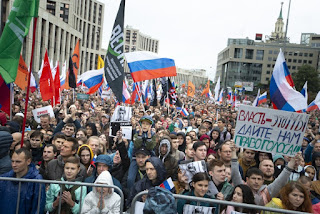
    Navalny has been challenging the Kremlin and calling for anti-corruption for years. His most recent criticism of President Putin is the video exposé - “Putin's palace. History of world's largest bribe”. In it Navalny explains the history of Putin’s corruption schemes and his rise to power, and he describes the extremely expensive palace by the Black Sea, which Navalny claims was built for President Putin. Navalny’s arrest together with his continued criticism of Putin and work for anti-corruption in Russia has inspired millions of people to protest his arrest and call for a better Russia. Not all protesters fully support Navalny, but they nonetheless risked being subjected to violence because they don’t want to live in a country where people are scared to speak out and they strongly believe Russians deserve better (Roache 2021). Thousands of people are being arrested and authorities are using violence and brutality against the protesters. Amnesty International’s Moscow Office Director, Natalia Zviagina, says that “Russian authorities have arrested so many people in recent weeks that detention centres in Moscow have run out of space, and peaceful protesters are being held in deportation facilities” (Amnesty International 2021). The fact that Russia is a centralized state with a high degree of autonomy and its history as a communist state offer some clarity as to why the government would have a strong reaction to protesters. The Kremlin's response to these peaceful protesters and the use of force to silence critics serve as a reminder of what those in power are willing to do to remain in power, completely disregarding what their citizens demand.


Shemetov, M. (2021). Law enforcement officers detain a man during a rally in support of jailed Russian opposition leader Alexei Navalny in Moscow, Russia [Photo]. Reuters. https://www.reuters.com/news/picture/russia-detains-thousands-at-protests-aga-idUSRTX8SS94

    Russia’s demand for less corruption and a better future is not an isolated case. Many parallels can be drawn between the Russian protests and the protests in Belarus against the electoral fraud in the presidential elections that pronounced a landslide victory for Lukashenko in 2020. Lukashenko has been the president of Belarus for 26 years and the opposition leader, Sviatlana Tsikhanouskaya, was exiled from her country. Like in Russia, authorities in Belarus have used violence against peaceful protesters. The government has subjected many journalists to intimidation, violence and jail, actively trying to silence everybody who would speak against Lukashenko (Bushuev 2021). Last August Lukashenko said that Putin had promised to help him in case he needed assistance to ensure control in Belarus. Both men have been in power for a long time and clearly signal to their citizens that they will not tolerate criticism and opposition. Both countries are facing major challenges with their governments which trying to hold on to power by enforcing means to silence those who voice their discontent.


Fedosenko, V. (2020). An injured man smokes a cigarette as he attends a rally following the presidential election in Minsk, Belarus [Photo]. Reuters. https://www.reuters.com/news/picture/street-protests-in-belarus-after-contest-idUSRTX7OMH7 

    We are yet to see what the protests both in Russia and Belarus result in - whether the vast number of people speaking up and demanding justice will awaken a greater democratic future or if the appalling use of brutality by the government will erase any such hope. Judging from the Russian government’s desire to once again be considered a super power (after loosing that status following the end of the Cold War) and the fact that it seems to be unbothered by threats of sanctions, we may expect authorities to continue to employ violence and for the country to move further and further away from the democratic model. 

Link to relevant information regarding the protests in Russia - https://www.amnesty.org/en/latest/news/2021/01/russia-appalling-use-of-force-and-arrests-of-peaceful-protesters/


References:

Reuters. 2020. “Constitutional changes are the ‘right thing’ for Russia: Putin.” https://www.reuters.com/article/us-russia-putin-constitution-idUSKBN2460OD (February 7, 2021).

Ray, Siladitya. 2021. “‘I Was In A Coma’: Navalny Ridicules Allegation He Failed To Meet Parole Officers In Moscow Court Hearing.” Forbes. https://www.forbes.com/sites/siladityaray/2021/02/02/i-was-in-a-coma-navalny-ridicules-allegation-he-failed-to-meet-parole-officers-in-moscow-court-hearing/?sh=51bd24323771 (February 7, 2021).

BBC. 2021. “Alexei Navalny: Russia’s Vociferous Putin Critic.“ https://www.bbc.com/news/world-europe-16057045 (February 7, 2021).

BBC. 2020. “Navalny ‘poisoned’: What are Novichok agents and what do they do.” https://www.bbc.com/news/world-europe-43377698 (February 7, 2021).

Bushuev, Mikhail. 2021. “The Lukashenko regime’s persecution of Belarus journalists.” DW. https://www.dw.com/en/the-lukashenko-regimes-persecution-of-belarus-journalists/a-56377758 (February 7, 2021).

Roache, Madeline. 2021. “‘The Whole System Needs Changing.’ The Russia Protests Are About More Than Just Alexei Navalny.” Time. https://time.com/5936827/russia-protests-alexey-navalny-inequality/ (February 7, 2021).

Amnesty International. 2021. “Russia: Appalling use of force and arrests of peaceful protesters.” https://www.amnesty.org/en/latest/news/2021/01/russia-appalling-use-of-force-and-arrests-of-peaceful-protesters/ (February 7, 2021).

Навальный, Алексей. (2021). “Putin’s Palace. History of world’s largest bribe.” YouTube. https://www.youtube.com/watch?v=ipAnwilMncI&t=1578s (February 7, 2021).


Featured Post

Turkey's Ban on Insults against Erdogan

 Since 2005 Turkey has had a law against insults against Erdogan known as Article 299. The article declares that citizens can be imprisoned ...