Wednesday, March 31, 2021

Obstruction of the Suez Canal

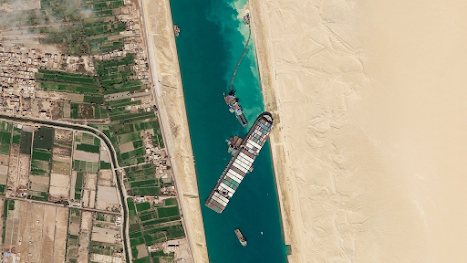
On Tuesday, March 23, the Suez canal obstruction began after a 200,000-ton ship was grounded due to a mixture of a sand storm with strong winds and human/technical error.  The Suez Canal, which links the Mediterranean and the red sea, had been blocked for about 6 days. On Monday, March 29, the canal finally was unblocked as tug boats were able to maneuver the grounded ship, “Ever Given”,  away from the land.
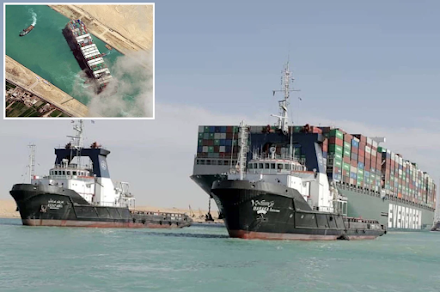
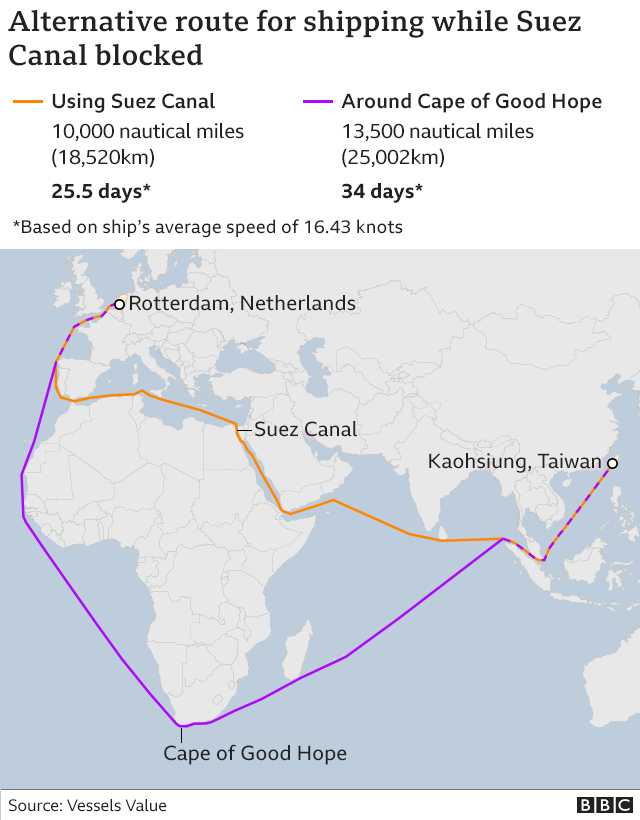
Due to this obstruction, some countries such as South East Asia and India had to detour all the way around Africa if they were trying to get to the western hemisphere. For some other ships, it caused a growing backup of up to 400 ships. This put a high risk on the cargo on the ships since there was some livestock aboard. The Ever Given was owned by a Japanese firm but operated by a Taiwanese shipper. However, this blockage will cause several months of disruption for the global supply chain since 80-90 ships pass through this canal a day, and around 10 billion dollars of trade pass through each day. More specifically, “about 12% of global trade, around one million barrels of oil and roughly 8% of liquefied natural gas pass through the canal each day”(bbc.com).  The prices of oils and other commodities have already increased due to this issue. Not only is the global shipping industry and the Egyptian economy affected by the blockage but it trickles down to the smaller business and industries too as there was a delay to receiving products. If the blockage continued to last some firms would have no choice but to order their products by air freight which is 3 times more expensive (bbc.com). The blockage is adding to the already existing problems of trade during the covid era, considering the difficulties of production and trade due to the desire to contain the virus.
Following the unblocking of the canal, more problems might arise, such as more congestion since many ships are waiting to take their normal sailing route. The majority of this issue will fall on individual consumers who have to pay for the rising prices of goods. This could generate more problems since some face financial struggles from covid. Some operations and regulations of the Suez canal are likely to change since over the years shipping vessels have been getting bigger and bigger. 


Sources


https://www.cnn.com/videos/world/2021/03/29/suez-canal-ever-given-ship-freed-effects-backlog-todd-dnt-tsr-vpx.cnn


https://www.foxbusiness.com/markets/with-ship-now-freed-a-probe-into-suez-canal-blockage-begins


https://www.bbc.com/news/business-56559073


https://nypost.com/2021/03/29/giant-ship-blocking-suez-canal-freed-but-economic-impact-looms/


Military Coup in Myanmar

Myanmar has a history of problems with the military: about 50 years ago an event happened similar to what is now unfolding. Previous to Ms. Aung San Suu Kyi election, she was a Myanmar icon, winning the Nobel Peace Prize in 1991. She did 15 years of house arrest, and after being released from house arrest her reputation was stained with the military. Ms. Aung San Suu Kyi was selected in 2016 for state counselor. Currently, Ms. Aung San Suu Kyi is waiting for her trial which is believed will take a year. In my opinion, this is to keep Ms. Aung San Suu Kyi in detention for the time being.

On the morning of February 1, 2021 a military coup seized power over the Myanmar government. The military refused to accept the votes Ms. Aung San Suu Kyi won. 83% of the available seats in the National League for Democracy had voted for her. The coup tried to argue that the votes were fraudulent. The military wants to hold a re-election for the country without any evidence that the votes were indeed fraud.


The coup took action and detained the leaders of the National League for Democracy. The military coup declared a state of emergency for one year because the 2008 constitution allows the military to do so. 

People opposed the coup through peaceful protests at first. Sadly, things took a sharp turn after two unarmed protestors were killed. Millions of people throughout Myanmar took the streets in rage. After weeks, protestors have been fighting for democracy but that has left hundreds dead and thousands injured. Out of desperation, people have gone into the countryside training with handguns and making grenades for a last stand against the military. Some think a revolution is the only chance of restoring the country to democracy.


A friend of ours lives in Myanmar. He had to get a secure app instead of whats app because he believed the military and government was watching his communications. He believes the struggles in Myanmar are not just domestic, but that foreing powers are also at play. Russians are coming in to try and help to stop the Chinese influence. In his view, if the Americans worked with the Russians, they could possibly stop what is happening in Myanmar and restore democracy. He thinks the Chinese government wants to take over, for example by financing the coup by the military. Life in Myanmar is dangerous: anonymous quote, “We were looking for a shop to put gas in our vehicle. We came across a roadblock on fire, but with a side lane to drive by. There were military and police on both sides. We slowed and they motioned us to pass.”

Domestic threats to democracy are sometimes stoked by foreign powers trying to gain influence in the region. You have to look at what's happening in a country, taking into account external influences as well as domestic struggles.


References

https://www.nytimes.com/article/myanmar-news-protests-coup.html

https://www.bbc.com/news/world-asia-pacific-11685977


Coup Attempt in Niger Days Before Bazoum's Inauguration


A political coup turned violent on Wednesday, March 31st, just a few days before the President-Elect is to be sworn in as Niger's new president. After years of political unrest, coups, and terrorism, Niger is supposed to see its first peaceful transition of power in decades. Mohomed Bazoum is scheduled to be sworn in Friday, April 2nd, replacing two-term president Mahamadou Issoufou. However, there are groups that are not pleased with the outcome of this democratic election. 


The event took place overnight from March 30th to the 31st. An armed military group attempted to overtake the presidential palace. The presidential guard was there and thwarted the attack by returning gunfire. According to witnesses, the shooting only lasted for 15-20 minutes but was still scary non the less. A few suspects have been arrested, but their identities have not been released. The president and president-elect are both safe, but the tensions are starting to rise in Niger as Islamic extremists increase their attacks across the country


Just under a week ago, there were a series of coordinated attacks that left 137 people dead throughout different villages in southwestern Niger. This occurred on the same day the Bazoum was declared the winner of the election by Niger's constitutional court. Being one of the most underdeveloped and poorest countries in the world, Niger is no stranger to violence. However, the increasing attacks are still caused for concern. Niger does not have large military capabilities, so their plan is to increase the number of trained troops in order to prevent and stop events like these from happening again. Currently, there are 25,000 troops in the army but the plan is to double that to 50,000 within the next 5 years. 


Clearly, President-Elect Bazoum will have his work cut out for him in his first 5-year term. He needs to get the violence under control and combat the terrorist groups that are wreaking havoc across the country. Hopefully, he is up for the challenge and can change the status quo of Niger for the better. 


References:

https://www.bbc.com/news/world-africa-13943662

https://www.bbc.com/news/world-africa-56589168

https://www.cnn.com/2021/03/31/africa/niger-attempted-coup-intl/index.html

https://www.france24.com/en/live-news/20210331-attempted-coup-in-niger-france-24

China's Patriot Plan and "Devastating blow to Hong Kong's democracy"

On March 30, 2021, the National People's Congress of China approved a resolution that will soon give China the power to vet and choose candidates for Hong Kong's Legislative Council (LegCo) elections. The resolution was entitled "Patriots Governing Hong Kong" and states that any person wishing to run for election must not be critical of Beijing, and must be a loyal supporter of the Chinese Communist Party. 

In order to ensure that these LegCo candidates are patriotic and loyal, they will be vetted and chosen by various Hong Kong Special Administrative Region (HKSAR) election committees and the national security police, all of which are pro-CCP and pro-Beijing.


While the popular vote will still be held to give voters a voice, the candidates appearing on the ballot will only be those preselected by the committees. Additionally, the popular vote will only be held for 20/90 Legislative Council positions, while the rest will be chosen by special sector groups. District Council positions were also changed from elected positions to appointed positions because the majority of those elected to those seats were pro-democracy. 

The resolution comes after a long number of pro-democratic protests in 2019 gained attention and pro-democracy officials either resigned or were removed because they were considered "threats to national security". Also, following these year long protests, a strict national security law was put in place that heightened the punishments for protestors, enabled Beijing to wire-tap or listen in on individuals, and allowed Beijing to be the primary interpreters of the law instead of Hong Kong's judiciary. 

Protesters rally inside the arrivals hall of Hong Kong International Airport on August 9. Photo: EPA-EFE


Other countries such as the U.S. and Britain have weighed in, calling the actions taken after the 2019 protests and this new electoral crackdown, anti-democratic. The British are particularly frustrated because Hong Kong was given back to China in 1997, by the British, with the intention to develop a "one country, two systems" approach. Since then, the freedom of speech, judiciary, and assembly, which are the unique freedoms for Hong Kong established in the "Basic Law" constitution, have been stripped away by Beijing. Dominic Raab, British press secretary, said this was "a clear breach of the Joint Declaration". 

However, not everyone agrees that this is all a plan to eradicate democracy. Other contributors, such as Ivan Choy, believe that this could be a reasonable attempt by Beijing to "reduce their dependence on the industrial and commercial sectors and on the big property developers" by placing the control in committees and others suggest that this could be beneficial in limiting politicization. 


Sources: 

https://www.nytimes.com/2021/03/30/world/asia/china-hong-kong-elections.html

https://www.bbc.com/news/world-asia-china-56534040

https://www.rfa.org/english/news/china/loyalty-03302021135238.html

https://www.bbc.com/news/world-asia-china-52765838

Picture Sources:

https://www.scmp.com/comment/opinion/article/3026763/hong-kong-protests-will-not-fizzle-out-their-own-beijing-needs


Tuesday, March 30, 2021

Deceptive Democracy in Rwanda


Twenty-seven years after facing a historic genocide leaving about 800,000 dead, Rwanda now finds itself stuck in an oppressive democracy moving closer and closer towards an autocracy. Endorsed by the Country's Supreme Court, a petition signed by more than 3.7 million people rejected and condemned President Paul Kagame's efforts to amend the new constitution (2004) and seek to stay in office until at least 2034. Besides disobeying unified calls against power abuse and authoritarianism, Rwandan efforts to support the Rwandan Patriotic Front (RPF party) by dismantling opposing campaigns and suppressing public criticism of the authoritarian government through violence "could jeopardize the country's stability in the long run," as announced in the Congressional Research Service's 2021 report.


Silencing critics through the use of violence is familiar ground for the Rwandan government. In one recent example (Feb 2021), a man named Seif Bamporiki, a Rwandan exile, was shot while sitting in his truck in Cape Town, South Africa. A friend of Bamporiki was able to escape unharmed. In another example, former Rwandan Intelligence Chief Patrick Karegeya was strangled to death in a hotel room in Johannesburg. In another case, a former army chief and member of the Rwanda National Congress (RNC) was shot in Johannesburg. The Rwandan government is criticized internationally by many countries and the United Nations regarding suspected human rights abuses, personal security, and the continued oppression of dissidents and the people of the country as a whole.

Other countries in the region aren't far behind on their way to autocracy as well. In 2005, a change to the Ugandan constitution allowed their President to continue to run for reelection for at least three more five-year terms. In Burundi, their President directly violated and disregarded their constitution by running and winning a third term. And in Congo, their President ignored criticism of power abuse by staying in office for 19 years and jailing opposition leaders.

Rwanda is no less guilty of power abuse and the blatant disregard for public opinion than these other countries. Despite efforts by President Kagame to gain and retain power at any cost (including leading a 1994 RPF revolution against an even more oppressive government), he still reportedly won reelection in 2017, gaining about 99% of the vote. This shouldn't come as a surprise. If the Rwandan government will send operatives across borders to protect their power by slaughtering exiled opposition leaders, why wouldn't they forge election results? And, even if the results are legitimate, the Rwandan people know no more than what information is spread by the overwhelmingly dominant RPF party. Without a platform for political opponents, democracy cannot prevail in a country. Without contest, there really is no "election" at all. Winning 99% of a "vote" against whatever opposition leader is lucky enough to not be exiled and assassinated isn't much of a "win" at all. The RPF's 27 years of continued efforts to dismantle opponents and retain power are not in the best interests of democracy in Rwanda. On paper, elections, opponents (such as the RNC), pardons for women who underwent abortions (which are strictly outlawed in the country), improvements from genocide, and categorization as a "democracy" all look great. However, taking a closer look inside will provide an abundance of evidence suggesting a threat to basic principles of democracy and a move towards Kagame's autocracy.


References:

Chutel, L., & Dahir, A. (2021, February 22). Rwanda opposition figure is killed in South Africa. Retrieved March 30, 2021, from https://www.nytimes.com/2021/02/22/world/africa/rwanda-seif-bamporiki-killing.html

Country dashboard. (2021). Retrieved March 30, 2021, from https://fragilestatesindex.org/country-data/

Herrera, A. (2019, April 12). Abortion pardons in Rwanda leave rights ACTIVISTS HOPEFUL. Retrieved March 30, 2021, from https://www.pri.org/stories/2019-04-12/abortion-pardons-rwanda-leave-rights-activists-hopeful

Rwanda genocide: 100 days of slaughter. (2019, April 04). Retrieved March 30, 2021, from https://www.bbc.com/news/world-africa-26875506

Rwanda: In Brief [PDF]. (2021, February 23). Washington DC: Congressional Research Service, from https://fas.org/sgp/crs/row/R44402.pdf

Rwandan President Paul KAGAME could rule UNTIL 2034 after VOTERS lift limits. (2015, December 19). Retrieved March 30, 2021, from https://www.theguardian.com/world/2015/dec/19/rwandan-president-paul-kagame-could-rule-until-2034-after-voters-lift-limits

The Fall of Democracy in Myanmar


On February 1, 2021, the Myanmar military staged a coup, detaining State Counsellor Aung San Suu Kyi and other democratic leaders and imposing military rule (BBC 2021). Protests against this military rule began in February and have continued since. On March 27, 2021, the deadliest day since the coup itself, more than 100 peaceful protestors, including children, were killed by the military (Beaumont 2021).

Buddhist monks lead a protest march against the military coup that overthrew the elected government in Myanmar in February. The Christian Science Monitor. 

Myanmar’s issues stem from a lack of effective institutions. Both freedom and equality as well as the means to protect them are lacking in this country. It has proven to be a weak state, unable to carry out necessary basic tasks: namely, enforcing the rule of law. Unable to enforce the rule of law, the state cannot keep the military in check. Because the state’s institutions are ineffective, Myanmar lacks legitimacy. Therefore, the military relies on coercion, not just through fear and threats but through brutal violence.

Myanmar’s democracy was never properly consolidated, and now, it has been replaced by military rule (Newsround 2021). Aung San Suu Kyi won the Nobel Peace prize in 1991 for her fight for human rights and democracy and her willingness to give up her own her freedom to challenge those who had ruthlessly ruled Myanmar for decades (BBC 2021). She won the first openly contested election in Myanmar in 25 years but in recent years has experienced a fall from grace, losing international supporters because of her refusal to condemn military action during the genocide of the Rohingya (BBC 2021). Beginning in 2017, the Myanmar military carried out a campaign of killing, arson, and rape against the Muslim Rohingya ethnic minority (Tyson 2021). The fall from grace of an icon like Aung San Suu Kyi is another example of Myanmar falling further from democracy.

As the Rohingya genocide shows, there has often been religious conflict in Myanmar, but in the face of the present military coup, different religious groups have unified in protest (Tyson 2021). Hope for democracy in Myanmar remains. The protest movement is an important sign of progress as citizens are willing to risk their lives to create a pro-democracy civil disobedience movement. As one Buddhist monk, Mandalar, put it “We have to help the people get their rights and freedom…If we deny the situation and don’t [get] involved, it’s a shame” (Tyson 2021). No one should have to live in a constant state of fear. Everyone deserves freedom and equality. This movement is developing a stronger national identity for the protestors, but this identity does not match up with the ideals of the state currently ruled by the military. The protestors believe in their own democratic political aspirations, not the authoritarian aspirations of the state.

Myanmar's military junta has continued a brutal crackdown on a nationwide civil disobedience movement. The Guardian (from Getty Images).

After Saturday’s events, the United Nations condemned the killing of peaceful protestors as did US President Joe Biden (Beaumont 2021). President Biden declared that the US will not trade with Myanmar until a democratic government is restored (Beaumont 2021). The United States is a strong state built on rational-legal legitimacy and citizens who believe in and accept the role of US institutions. The US has many problems, but in comparison to Myanmar, the strength of US institutions makes it difficult for the complete overthrow of democracy that occurred in Myanmar to occur in the United States. However, it’s important to keep in mind that there is some hope for the restoration of democracy and a better future for Myanmar through international support if its people continue to come together and fearlessly fight for democracy, freedom, and equality even in the face of extreme military action.


References
BBC News. 2021. “Aung San Suu Kyi: Myanmar Democracy Icon Who Fell from Grace,” March 5. https://www.bbc.com/news/world-asia-pacific-11685977 (March 29, 2021).
Beaumont, Peter. 2021. “US to Stop Trading with Myanmar until Return of Democratic Government.” The Guardian, March 29. https://www.theguardian.com/world/2021/mar/29/biden-and-eu-condemn-myanmar-bloodshed-as-outrageous-and-a-day-of-shame (March 29, 2021).
Newsround. 2021. “Myanmar: Why Are People Protesting?” BBC, March 28. https://www.bbc.co.uk/newsround/56554156 (March 29, 2021).
Tyson, Ann Scott. 2021. “Myanmar Protesters Bridge Religious Divides to Counter Military Coup.” The Christian Science Monitor, March 26. https://www.csmonitor.com/World/Asia-Pacific/2021/0326/Myanmar-protesters-bridge-religious-divides-to-counter-military-coup (March 29, 2021).

Mexico cracks down on Private Gas Stations

 FILE - In this Jan. 14, 2019 file photo, workers discharge gas from a truck to supply a gas station with fuel in the Iztapalapa area of Mexico City. Mexican President Andres Manuel Lopez Obrador said Monday, March 29, 2021, that has sent a bill to co


Mexican President Andres Manuel Lopez Obrador has proposed a law that would weaken private gas companies and strengthen the state owned corporation, Pemex. Mexico had only started allowing private gas stations as recent as 2016. However upon their arrival, they began to rapidly take a large portion of the market away from the state backed company Pemex. Pemex stations are known for their low priced fuel and for “shorting customers on the volume of fuel delivered” (ABC). The new problem is that these private companies have been importing more oil and fuel without paying any tax on it. This law proposed by President Lopez Obrador, intends to close down any private company not paying taxes on imported gasoline and give their stations to Pemex. This is in order to combat the tax evasion on gasoline imports but also part of Lopez Obrador’s larger plan to end gasoline imports all together. Part of Lopez Obrador’s policy plans are to build oil refineries in Mexico and to not export any more crude oil, but rather to process it in house. He plans for Mexico to produce all the gasoline they consume so they do not have to import. In this plan, he also mentions the idea of bringing in foreign companies to build wind and solar farms to begin a transition to cleaner energy. Lopez Obrador said of the situation “We have to be self-sufficient, these are strategic activities so that Mexico can continue to be an independent and sovereign country”(ABC). The proposed law would allow for more state controlled markets and allow Pemex to strengthen its position amongst other private companies. 


A similar law was proposed in 2019, when Lopez Obrador had asked congress to protect against fuel theft. The country’s gasoline reserves were traditionally transported using pipelines but since cartels and other organizations had begun to breach the pipelines and steal fuel, the gasoline is now transported through trucks and trains usually escorted by armed police. Due to this slower, less efficient method of transportation, a “fuel shortage” was observed. The fuel simply takes longer to get to stations and in that time, they run out and close down. Customers are not able to readily get gas and as a result, they must wait in hour long lines at the few places that do have gas. It is an unfortunate consequence of Lopez Obrador’s response to fuel theft. Lopez Obrador said “there is enough gasoline in the country, but we cannot use the pipelines because there are networks that were created to steal gasoline, alternate networks”(Sieff). 


References: 


https://www.washingtonpost.com/world/the_americas/gas-stations-in-mexico-run-out-of-gas-as-government-cracks-down-on-fuel-theft/2019/01/09/a9e71da8-1431-11e9-ab79-30cd4f7926f2_story.html 


https://abcnews.go.com/International/wireStory/mexico-president-seeks-clamp-private-gas-stations-76758181

https://www.npr.org/2019/01/08/683381485/widespread-gas-shortage-in-mexico-as-government-tries-to-thwart-fuel-thieves


Monday, March 29, 2021

The French Farming Feud

2,000 french farmers and 400 tractors descended into Pace de Jaude, the city square of Clermont Ferrand, France, on March 25. The farmers were protesting the new Climate and Resilience Bill aimed at taxing the use of nitrogen fertilizer. The farmers described this nitrogen fee as “punitive and unfair” and would “stigmatize” the use of chemical fertilizer without providing any alternatives for the farmers to use (Neal, 2021). The protest was coordinated by the FNSEA, France’s largest farmers’ union (Martin, 2021). 


Tractors rammed down the street signs and lamp posts as the farmers that were tractorless dumped manure into the streets and the sidewalks. It was, needless to say, a pretty messy situation. The protest started at 10 a.m but ended around 5 p.m as French police fired tear gas into the crowd (Neal, 2021). This aggravation within the French farming community against French policies isn’t something new. Farmers in 2019 protested stagnant revenues and unfair competition. During this protest the tractors remained parked on the highway circling Paris and they said they would remain there until French President Emmanuel Macron agreed to meet with protesters (Parker, 2019). Clearly, within the next couple of years not a lot has changed, and the farming community is still very frustrated with their government. 


The union said that the new legislation had ignored the changes the farmers’ had already been making and that the new bill would reduce farmers’ incomes without giving a “real response” to climate issues currently happening in France (Martin, 2021). The potential fertilizer fee paired with the Egalim Law, which has put agriculture produce prices well below production costs, could cause some serious problems with farmers and their families especially in a pandemic (Neal, 2021).


Many make the argument that the Bill is unnecessary due to the fact that the nitrogen balance has decreased tremendously in the last couple of years and that this bill sweeps away all the efforts made by the agricultural profession (Martin, 2021). This is also bad for the economy as a whole because it risks distorting differences in the competitive market already existing between France and other countries (Martin, 2021).

Sources:

https://www.agriland.ie/farming-news/french-farmers-take-to-the-streets-of-clermont-ferrand-to-protest-fertiliser-tax/

https://www.peoplesworld.org/article/french-farmers-protest-fertilizer-tax/

https://apnews.com/article/7d51bbf297fb4da6bbcb7a13eb0bc12d


Myanmar's Struggle to Maintain Democracy


Over the past decade, Aung San Suu Kyi, a democracy icon, grew in popularity among the Myanmar people, as she was a strong supporter of peaceful resistance of the military (Cuddy). Myanmar has a long history of military ruling. In 2015, Aung San Suu Kyi won the election which was one of the first openly contested elections in 25 years in Myanmar (Cuddy). When Aung San Suu Kyi refused to stand up for Myanmar’s Rohingya Muslim Minority, her popularity plunged overseas (Cuddy). However, at home, she was still favored by the majority Buddhist population (Cuddy). In 2020, her and her party won re-election and almost completely wiped out the pro-military opposition (Cuddy). The military claimed that there was voter fraud, even though there was no evidence of such intervention (Cuddy). 


On February 1st, a coup began to unfold (Cuddy). Aung San Suu Kyi, along with other civilian leaders were arrested, even though they were rightfully voted into power (Cuddy). The military then announced a year-long state of emergency and said that they were going to hold new elections (Cuddy). A large population of the Myanmar people came to the streets and protested (Cuddy). The protesters were angry that the leader that they voted in was taken down and they demanded that democracy be restored (Cuddy). The protesters were hit with “water cannons, rubber bullets and live ammunition” by the military in order to control the crowds (Cuddy). Hundreds of protesters have been killed, according to the “Assistance Association for Political Prisoners” (Stringer). 


Aung San Suu Kyi has been held by the military since the coup and is facing charges for several violations (Cuddy). Some of these violations include “possessing illegal walkie-talkies, violating Covid-19 restrictions during last year’s election campaign and publishing information that may ‘cause fear or alarm’” (Cuddy). 


Myanmar’s military junta chief Min Aung Hluaing has taken over Myanmar as a result of this coup (Regan). Over 3,000 people fled to Thailand from Myanmar’s southeastern Karen state after military jets bombed and killed hundreds of unarmed people (Regan). Many civilians have fled their homes and are hiding in the jungle (Regan).


After researching this topic it is apparent that Myanmar will continue to remain in chaos until an election is held that is respected by all parties. Will the citizens settle for an election run by the military? Will the military ever allow a true democracy?


Additional Resources:

https://www.cnn.com/2021/02/16/asia/gallery/myanmar-unrest/index.html

https://www.bbc.com/news/world-asia-55902070

https://www.bbc.com/news/world-asia-56331307

https://www.cnn.com/2021/03/29/asia/myanmar-deadly-weekend-intl-hnk/index.html


Macron Warns Turkey Not to Interfere In French Elections


Over the past week, French President Emmanuel Macron accused Turkey of meddling in the 2022 French Election. These allegations are part of an ongoing feud between Macron and Turkish President Tayyip Erdogan (Voanews). These new allegations by Macron have put any ongoing negotiations between Turkey, and France to a halt. 

(dailysabah.com)
Macron alleges that nongovernmental organizations (or NGOs) in Europe are being used by "Turkey's official propaganda organs"(dailysabah.com) to either interfere in elections or interfere in the financing of organizations(dailysabah.com). Members of the Turkish government were appalled by Macron's recent accusations. The spokesperson of Turkey's ruling Justice and Development Party (AK Party) called these allegations unacceptable and said that Macron was "out of line" (dailysabah.com). However, it is important to note that President Erdogan has previously been accused of interfering in elections. In 2017 he came under fire for meddling in the election of German chancellor Angela Merkel (voanews). However, nothing came of these allegations, as Merkel, was elected, and Erdogan did not face any punishment. 

(voanews)
This kind of tension between France and Turkey is nothing new, these two countries have been at odds over geopolitical conflicts in Syria and Libya for a few years(dailysabah.com). This political conflict originates mostly from differing views on religion. Macron has at times been outspoken against radical Islam, Erdogan on the other hand is Pro-Islam, this has only added to the tension between the two nations. In addition to these political conflicts, Macron and Erdogan have gotten into a number of public arguments. The most recent came after President Macron made some controversial comments about Islam's prophet Mohammed. These comments were made following the terrorist attacks in France, in which Macron went on to call Islam a "religion in crisis"(dailysabah.com).  Erdogan and the rest of Turkey took Macron's comments as a direct assault on the religion of Islam, furthering the divide between the two countries. 

This latest allegation by Macron threatens to ruin peaceful negotiations between France and Turkey. With the election coming up in one year it is crucial for France and Turkey to be on good terms. Ultimately, the relationship between these two countries is worsening, and it will be interesting to see how Macron's recent comments impact the results of France's upcoming election. Hopefully, the arguments between the two Presidents do not hinder any future negotiations between the two countries.
(Arab News, 2020)


References:
Afp. “Erdogan Hopes France Will 'Get Rid of Macron' as Soon as Possible.” Arab News, Arabnews, 4 Dec. 2020, www.arabnews.com/node/1772526

Agency, Anadolu. “Macron Reiterates Claim Turkey Attempting to Interfere in French Elections.” Daily Sabah, Daily Sabah, 27 Mar. 2021, www.dailysabah.com/politics/diplomacy/macron-reiterates-claim-turkey-attempting-to-interfere-in-french-elections.

“Macron Warns Turkey Not to Interfere in French Elections.” Voice of America, www.voanews.com/europe/macron-warns-turkey-not-interfere-french-elections.

Featured Post

Turkey's Ban on Insults against Erdogan

 Since 2005 Turkey has had a law against insults against Erdogan known as Article 299. The article declares that citizens can be imprisoned ...