A former student and friend sent me this article. Thought it would be interesting to re-post. She didn't include the source, other than that Gerald Caplan wrote the article.
The Live 8 concerts: Hold on Africa – here we come!
Gerald Caplan (2005-06-23)
With the global music extravaganza that is Live 8 just around the corner, Gerald Caplan is nervous about the crocodile tears shed for Africa by leaders like Tony Blair. Caplan writes that the job of Bono, Bob Geldof and other Live 8 organizers is to let their fans know that Africans need no more missionaries or do-gooders. “Instead, Africans have a right to justice and equity to make up for the incalculable harm that we in the rich world have inflicted on them for such a long, long time,” writes Caplan.
Everybody must be aware by now of the Bob Geldof Live 8 spectacular coming at us next week. The media has been abuzz with burning questions about where the concert will be held and who'll be performing, with a sentence occasionally thrown in about saving poor old Africa or ending poverty. This is a serious problem.
Getting it wrong about Africa is a venerable tradition in the rich world, and music has played its role. Remember the great famine concerts of 20 years ago and the giant hit "Do They Know It's Christmas?" It's just been re-recorded, with its inane lyrics of Africa as a land "underneath a burning sun…where nothing ever grows" and "no rain nor river flows". Get it? Natural causes---bad luck—are at the root of Africa's problems.
Television does its share. Who among us haven't seen inspiring stories about young Canadians who decide to raise pennies for a well or school in Africa? These efforts are invariably motivated by the best of intentions. But I'm concerned with their unintended message. I fear they reinforce wrong-headed stereotypes of both Africa and us. To my eye, they show Africans as helpless, dependent, passive victims, and we westerners as decent, selfless, compassionate, resourceful missionaries.
Now Paul Wolfowitz's has added his explanation for Africa's plight. Moving swiftly from being a maven about Iraq to becoming an authority on Africa's 53 countries, the new head of the World Bank has just completed a whirlwind learning tour of the continent—6 days, 4 countries. The problem in Africa, he announced at the end, is simple: "corruption". Right. If only Africa's leaders were more like our own.
These views reflect a common theme: they leave the rich world blameless for Africa's multitude of problems. I greatly fear that Live 8 is inadvertently strengthening the notion that we in the rich world must be missionaries to save Africans from themselves. The truth is already being lost-- the deep, comprehensive responsibility of western nations and western financial institutions for so much of Africa's continuing underdevelopment and poverty. The real reason the rich world should be racing to deal with African poverty is the central role we have played in causing and perpetuating it. Has anyone told Paul Wolfowitz that vastly more money pours out of Africa each year back to rich countries than flows in? That's the key to Africa's development crisis, and it's almost entirely unrecognized.
The responsibility of the rich world takes many forms. It includes the indispensable support given over the decades to countless African tyrants and to white racists. It includes the demonstrably retrograde free market policies imposed on virtually every Africa government by ideological extremists at the World Bank and International monetary Fund (also known by African pediatricians as the Infant Mortality Fund) and backed by almost all western governments, including Canada. Across west Africa, it's cheaper to buy a subsidized frozen chicken imported from Holland that to buy one from a local producer. Foreign aid is always tied to buying goods and services in the rich country or to sending consultants to Africa to make more in a day than the vast majority of Africans do in a year. Rich countries drain off a huge percentage of the professionals—doctors and nurses, especially—who are trained in African universities. Western corporations plunder Africa's natural resources, pay starvation wages and almost no local taxes, bribe anyone in charge—corruption!--pollute hideously, and leave conflict and human rights abuses in their wake. Western donors demand that user fees be imposed on health services and tuition fees on schooling. They demand that public services be slashed so that health and school systems deteriorate. The US government and fundamentalist western religious groups introduce unrealistic and irrelevant moral dogmas to combat AIDS and undermine evidence-based methods of prevention
Anyone who doesn't distrust the Group of 8 leaders who'll be meeting next month hasn't been paying attention. They're the ones responsible for the economic apartheid that characterizes rich-poor country relations today. Every one of them has failed to live up to repeated pledges about aid, debt relief and agricultural subsidies, solemnly made and blithely ignored. The recent ballyhoo about debt relief for 14 African countries was wildly overblown; it was no more than a modest first step. The more leaders like Tony Blair and Paul Martin shed crocodile tears talk about their moral crusade for Africa, the more liberal imperialist rhetoric they spin, the more nervous we should be. The job of Bono and Bob Geldof and other Live 8 organizers is to let their fans know that Africans need no more missionaries or do-gooders. Instead, Africans have a right to justice and equity to make up for the incalculable harm that we in the rich world have inflicted on them for such a long, long time.
* Gerald Caplan works with various UN agencies on African development issues.
Tuesday, March 21, 2006

Saturday, February 25, 2006
Uganda: A Test Case for African Democracy
So, President Museveni of Uganda pulled off a 59.3% victory in Uganda's recent multiparty Presidential elections. Kudos to Ugandans for having a relatively violence-free election. Kudos also to Ugandans for showing up to vote -- 59.3% turnout -- the Western democracies could be so lucky with such a high-level of voter participation.
The most important test for Uganda's democracy still remains: what will happen after the elections? Neither side should advocate violence, although it may be inevitable. Uganda, with all of its economic successes has really become a test-case for African democracy. It it cannot succeed in Uganda, where can it in Africa?
The most important test for Uganda's democracy still remains: what will happen after the elections? Neither side should advocate violence, although it may be inevitable. Uganda, with all of its economic successes has really become a test-case for African democracy. It it cannot succeed in Uganda, where can it in Africa?
Wednesday, February 22, 2006
Museveni: The Answer for Uganda?
Ugandans are once again testing their resolve for democracy. It's easy for us in the West to criticize Ugandans for not seeing through Yoweri Museveni's "Big Man" politics, but when the "Big Man" implies that he will "go back to the bush" if he doesn't win, and reminds people of the chaos and violence that beset Uganda pre-Movement politics, it's no wonder that Ugandans will probably vote for "no change" in Thursday's presidential elections.
It's also no wonder that Dr. Kizza Besigye is behind in the polls. As Emily Wax's Washington Post article, "Ugandans Put "Big Man" Politics to Vote", outlines, Besigye had to try and win the hearts and minds of Ugandans while going from a maximum security prison on charges of treason and rape, to multiple court appearances.
Perhaps we should applaud the fact that Museveni just didn't have Besigye killed when he returned to Uganda -- Museveni has obviously become more sophisticated than previous Ugandans rulers in underming the opposition.
My guess is that Museveni will win tomorrow -- not because he is necessarily the best man for the job, but because he has established himself as the "big man" for the job.
It's also no wonder that Dr. Kizza Besigye is behind in the polls. As Emily Wax's Washington Post article, "Ugandans Put "Big Man" Politics to Vote", outlines, Besigye had to try and win the hearts and minds of Ugandans while going from a maximum security prison on charges of treason and rape, to multiple court appearances.
Perhaps we should applaud the fact that Museveni just didn't have Besigye killed when he returned to Uganda -- Museveni has obviously become more sophisticated than previous Ugandans rulers in underming the opposition.
My guess is that Museveni will win tomorrow -- not because he is necessarily the best man for the job, but because he has established himself as the "big man" for the job.
Monday, December 05, 2005
Democracy: The Answer or the Disaster?

By Matt. G.
It is not surprising that there are many who feel that democracy will never work in Africa. There is a lot of evidence to support this claim. Look at the countless countries who, after independence from the west, set forth with such high democratic or socialist goals just to meet severe disappointment less than a decade later. There are some who feel Africa is just not ready for successful sustainable democracy. Some place the blame on the fact that western, or liberal democracy, was not developed to suit the conditions of Africa. Noted Nigerian born sociologist said that Western style liberal democracy could not work in Africa because it is a, “society which is still pre-industrial and communal and whose cultural idiom is radically different [from the West].”(Ake 239) While I agree that it would be foolish to simply take western models of democracy and paste them over African countries, I believe that some type of democracy is in the best interest of African people in the present and in the future.
I do not buy the argument that democracy will not work in Africa because the society is not ready. First, democracy does seem to be at least burgeoning in several Sub-Saharan African states like Ghana or South Africa. While possibly an oversimplification, I agree in spirit with the claim, “A country does not have to be deemed fit for democracy; rather, it has to become fit through democracy.”(Sen 4) It is true, some states are more resistant than others to successful democracy, but failures in the past and difficulty in the future should not be a legitimate cause to drop the entire movement. It was not democracy that has failed in Africa, but the states that claimed to be reaching for it. A combination of inept leadership and poor structure has, “turned the high expectations of the independence movement into painful disappointment.”(Ake 240)
One of the other arguments against democracy in Africa is that the people would have to pay too high an economic price for the eventual promise of a more free and open society. This is the argument leaders like Yoweri Museveni have used to defend against those who believe that governments need to further democratize. Unfortunately this is a relatively common belief among Africa’s “New Leaders.” Though not as visibly autocratic and ruthless as earlier post-independence leaders like Zaire’s Mobutu Sese Seko, this new breed of African leadership seems no less interested in long term democratic reform that does anything but support their own bid for power.(Richburg 131)
These “New Leaders” appear to, “all subscribe to the notion that economic development precedes democracy, and reject the view that democratization and development are mutually supportive processes that occur at roughly the same time.”(Gordon 123) This is a false belief being put forward by rulers only interested in maintaining their own power. The actual truth is that “In Africa, the return to economic growth has been inextricably linked to political reform.”(Gordon 125) While this can not be claimed true in all situations, like that of Museveni’s economically successful “no-party” Uganda, it is an overall trend.
I do not doubt that Museveni has pursued successful economic policies during his tenure as the leader of Uganda, but what is to stop him from reversing his policies at whim? It was not so long ago that the Robert Mugabe sent a relatively successful Zimbabwe into economic free fall. Museveni’s recent arrest of his strongest political adversary does not convince me that his liberal economic policies truly reflect a support for Western ideals of a free and open society.(Lacey)
While I understand that opening the democratic process to more free and fair competition brings with it the fear of greater instability, lack of openness eliminates the protective qualities of democracy. It is clear that, “political and civil rights give people the opportunity to draw attention forcefully to general needs and to demands appropriate public actions.“(Sen 7) One compelling fact is that, “in the terrible history of famines in the world, no substantial famine has ever occurred in any independent and democratic country with a relatively free press.”(Sen 7) Where else in the world would the ability to resist famine be more applicable than Africa with the long going famine in Sudan and the recent famine in Niger.
Democracy does not only protect against famine or promote economic growth, but protects human rights as well. While human rights may mean different things to Africans it is not some Western ideal, human rights are an international goal. While democracy does not automatically mean there will be a respect for human rights, there are some long democratic countries in Africa with poor human rights records, it would seem that human rights are a goal only reached through democracy.(Aidoo 705) Akwasi Aidoo states it clearly when she says, “the full range of human rights cannot be guaranteed unless they are specifically promoted and protected in law and by popular organizations.“(707)
While I know that there are further criticisms of the viability of democracy in Africa, they are all of the same ilk. While democracy may have been born in the West, it is not limited in scope to Western civilization. African states need accountable, law based, and free states if they ever hope to improve not just the economy, but the lives of their peoples. But these governments can not be manufactured from the outside. Africa needs domestically created democratic governments better fit to the social and economic needs specific to African nations. Hard times are probably ahead for Africa, but letting go of democracy will only maintain the status quo of underdevelopment, famine, and human rights abuse in Africa.
Works Cited
Ake, Claude. “The Unique Case of African Democracy.” International Affairs. Vol. 69, No.2 (1993): 239-244.
Sen, Amartya. “Democracy as a Universal Value.” The Global Divergence of Democracies. Eds. Larry Diamond and Marc F. Plattner. Baltimore: Johns Hopkins University Press, 2001. 3-17.
Richburg, Keith B. “Africa’s Rulers Do Not Support Democracy.” Africa: Opposing Viewpoints. Ed. William Dudley. San Diego: Greenhaven Press, 2000. 130-136.
Gordon, David. “Africa is Moving Toward Democracy.” Africa: Opposing Viewpoints. Ed. William Dudley. San Diego: Greenhaven Press, 2000. 119-129.
Aidoo, Akwasi. “Africa: Democracy Without Human Rights?” Human Rights Quarterly. Vol. 15, No. 4 (1993): 703-715.
Lacey, Marc. “Uganda: Opposition Leader Sent to Court-Martial.” The New York Times. November 26, 2005. http://query.nytimes.com/gst/fullpage.html?res=940CE1D91731F935A15752C1A9639C8B63 (December 1, 2005).
Monday, November 28, 2005
Is Famine a Man-made or Natural Disaster?
 In Asia, Africa and Latin America, well over 500 million people are living in "absolute poverty". over 9 million people die worldwide each year because of hunger and malnutrition. 5 million are children. Some 1.2 billion people suffer from obesity. For the price of one missle, a school full of hungry children could eat lunch every day for 5 years. EVERY 3.6 SECONDS, SOMEONE DIES OF HUNGER. Famine is the last hurrah of long-term hunger. How does this persist in the 21st Century?Zimbabwe, Malawi, Zambia, Niger, Ethiopia...the list keeps growing of countries that are currently or will soon be experiencing famine. How can this continue?
Below, see some perspectives from our guest blogger, Jamie P (The imagine is taken from the following website? members.tripod.com/ ~afronord/hsdoc/famine.jpg)
Is Famine a Man Made Problem?
Famine can be traced back to the roots of civilization and seen throughout the annals of history. This empirical fact leaves one to conclude famine is inevitable, given the occurrence of natural disasters associated with the passage of time (http://library.thinkquest.org). And while environmental catastrophes have reigned supreme as the cause of famines for many years, is it still true today? In other words, economically and technologically speaking, does the world today possess a certain prowess that would allow man to circumvent the hardships inflicted by Mother Nature? One scholar laments that “Once we begin to see beyond the rather seductive and ironic depictions of the famine encounter, we will be in a position to recapture a glimpse of the real causes of famine and cautiously avoid the conflation of natural calamities with ‘man made’ famines”(Araia). Yet, other experts cling to environmental attributions, stating that natural disasters still lie at the root of all widespread hunger (FitzGibbon and Hennessy). I would argue, however, that while this second point, respectively, may initially be the culprit, pernicious famine is exacerbated largely by man. Thus, while Mother Nature may initiate hunger, man bears the onus for creating or at least not averting widespread famine.
Famine may be referred to as ‘the regional failure of food production or distribution systems, leading to sharply increased mortality due to starvation and associated disease…’ (FitzGibbon and Hennessy). Historically speaking, in a majority of the situations where this definition comes into play, natural disasters are the initial cause. Many possibilities exist within this realm including drought, earthquakes, flooding, tidal waves, and insects such as locusts (http://library.thinkquest.org/).
Pestilence is also an environmental condition which can lead to famine. It is commonly known that diseases of epidemic proportions such as AIDS and Malaria are highly prevalent in many of the African countries. These Sub Saharan territories, in which the threat of famine always exists, are crippled when entire chunks of the population fall prey to these infectious diseases which thus severely curtail a population’s ability to produce or acquire food (http://news.bbc.co.uk). Yet, while all of these environmental issues, are certainly problems, countries internally and internationally should be able to circumvent these issues to prevent the wide spread famine that follows the initial hunger.
The natural disasters stated above do not necessarily result in a famine. A flood may wipe out the crops for an entire country which causes initial hunger; yet, famine happens later when many die of starvation due to poor governance. Colonialism is an example of this phenomenon.
The colonialization of the imperial powers in the African countries caused many problems. Their insistence on growing cash crops continues today so that “…the persistence of using good land to grow ‘cash crops’ such as coffee, tea or cashews for export, continues in many countries today. Often the best land is used in this way” (FitzGibbon and Hennessy). In addition, the problem is not exactly lack of rainfall “…but the vulnerability of a given society that wholly depends on a rain-fed agriculture” (Araia). Theories abound as to why exactly Africa remains underdeveloped today. Whatever the exact cause may be, exploitation of colonial powers certainly did not help Africa’s long term development. This underdevelopment only perpetuated famine today.
Poor governmental planning is also a cause of famine. While a natural disaster may devastate the crops in a region, a sound government should have stored enough food or resources to acquire sufficient provisions to prevent widespread death from starvation. Also, the world community should step in to remedy the problem. Poverty is also rampant in Africa, and many situations occur in Sub Saharan countries today where food exists but the people are simply to poor to buy it. Obviously, fixing these solutions are easier said then done; yet, it demonstrates how in these circumstances, famine is caused by man and not the environment.
In addition to man exacerbating the hunger that stems from a natural disaster, certain famine occurs completely void of environmental problems. War, including internal strife, which persistently has ravaged the African continent for decades, often involves pillaging, looting, and burning. This has caused thousands to go hungry and die as a result of this man made famine (FitzGibbon and Hennessy).
Another example of man made famine is genocide. Often, dictators in power will suppress food from their enemies in order to eliminate them. Hunger is also used as a tool in order to cause certain sects of the population to comply. Sometimes, it can be harnessed as a means of punishment. Examples include Ethiopia and the Sudan where internal strife and the government’s suppression of food for factions of their populations occurred. Graft can also produce famine in a population. In corrupt governments, which are pervasive in Africa, food and aid from other countries is sometimes confiscated by corrupt officials who then sell the resources for their own profit preventing the aid from getting to the people it was intended for (FitzGibbon and Hennessy).
Sudan serves as an example of a direct link between government and famine. In this case, in 1997, the northern government decided it would not allow international planes to land in the South to administer aid because of the civil war that was occurring. In essence, they thought that by stopping the aid, they could eliminate their enemy by starving them to death and also illicit support by placing blame for the food shortage on their enemy (FitzGibbon and Hennessy).
A similar example occurred in Ethiopia in the mid 80’s where the government halted the flow of food into Eritrea during a famine because of threatening rebel forces. “Through these actions, the government hoped to reduce the support for Eritrean rebels, and eventually to force them to surrender. However, these acts caused many thousands of deaths within Eritrea” (FitzGibbon and Hennessy)
Another example in which government is to blame is Niger. Nigerian leaders denied there was a food shortage and turned away 19 million dollars from the World Food Programme (WFP). The governmental leaders accused the WFP of exaggerating the problem and denying the mass starvation (http://news.bbc.co.uk).
Natural disasters certainly are a problem and they live up to their name, disaster. Today, however, it seems that man is the true disaster in regards to famine. Examples abound where famine after a natural disaster could have been prevented if there had been proper planning and support from the international community. If utilized properly, technology, production, and distribution could ensure that there are adequate resources to feed the entire world population. Also, in today’s day and age, famine is solely a man made problem with the persistence of poor governance, war and poverty. Despite natural disasters being the root of some hunger and loss of food, man is the ultimate cause of death due to starvation.
Helpful Websites: http://chora.virtualave.net/ghelawdewos-famine2.htm
http://www.ucc.ie/famine/roots/pdfs/Roots%20of%20Famine2
Monday, November 21, 2005
Zimbabwe: On A Fast Track to Disaster?
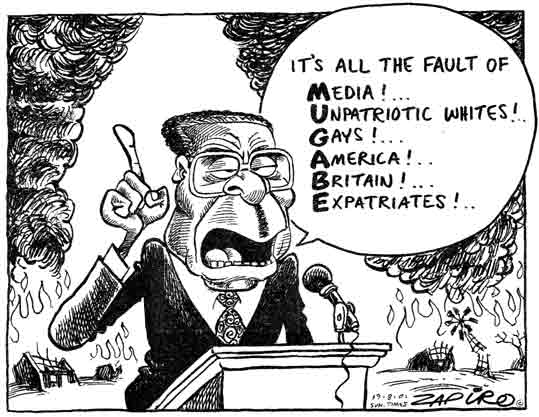
Freedom fighter, patriot, "revolutionary hero". Robert Mugabe has held many titles, but his most recent is perhaps most fitting according to Stacey H., below: cartoon figure of the archetypal African dictator". Two guest bloggers, Stacey H., and Kate D., offer their perspectives on the issues.
Mugabe: The Face of Zimbabwe
A person’s first impression of Africa usually focuses on negative aspects plaguing the continent like poverty, AIDS, and genocide. Africa has its success stories that can prove those initial impressions wrong, but countries like Zimbabwe only encourage the stereotype that many Africans are trying to disprove. Once hopeful and growing, Zimbabwe has taken a turn for the worse. It became independent in 1980 at the end of a struggle that transferred control from a small white community to current President Robert Mugabe. Initially, it appeared as though Mugabe would improve stability throughout the country. Zimbabwe had the ability to prosper because of its promising markets built around tobacco, agricultural products, and cotton. Nowadays, Mugabe’s country is plagued with poverty, high unemployment rates, civil strife, and a weakening economy. It is clear that Mugabe has been causing more harm than good, leading Zimbabwe into a crisis.
Beginning with the Land Acquisition Act of 1992, President Mugabe has been obtaining land for redistribution. Following the land seizures, government-backed militia killed several white farmers and their workers. Over the past five years, Mugabe has increasingly allowed the seizure of white-owned commercial farms, providing his supporters with the opportunity to prosper. However, Mugabe’s plan has decreased Zimbabwe’s overall production, leading to the breakdown of its agricultural-based economy. In April of 2002, the government declared a state of disaster charging that a drought had generated food shortages. Mugabe has also claimed that the people in Zimbabwe are “very, very happy” and not going hungry, despite aid organizations’ estimates that 4-11.6 million Zimbabweans are facing starvation [1].
People continue to blame drought for Zimbabwe’s deteriorating situation, but recently, Deputy Agriculture Minister Sylvester Nguni explained “that people without the slightest idea of farming got land” [2]. Even Zimbabwe’s Central Bank governor expressed that the Zimbabweans were using their new land in a “criminal” manner [3]. Zimbabwe’s agricultural output has been dropping since the land reform program intensified in 2000. Also, its overall economy and way of life have been suffering. In 2002, 70% of Zimbabwe’s population lived below the poverty line as opposed to the 60% in 2000 [4]. Also, Zimbabwe has the world’s fourth worst rate of HIV/AIDS and the highest rise in child mortality of any nation [5]. Christopher Dell, the United States ambassador to Zimbabwe said that “the Zimbabwe government’s own gross mismanagement of the economy and its corrupt rule has brought on the crisis” [6]. Mugabe is unwilling to manage the crisis since he will not take responsibility for Zimbabwe’s growing problems.
One of Mugabe’s most recent projects was his “Operation Murambatsvina” or “Operation Clear the Filth” beginning on May 19th, which involved the arbitrary destruction of urban slums and “illegal” buildings. The destruction displaced thousands into rural areas without access to health care, clean water, and economic support. Mugabe claimed the demolitions would increase law and order in the cities, as well as development. However, the UN has estimated that 700,000 people have been left without jobs or homes [7]. Audrey Gaughran, an Amnesty researcher asserted that Operation Murambatsvina was “the latest manifestation of a massive human rights problem in Zimbabwe that’s been going on for years” [8]. Mugabe’s government has also stalled UN aid to the many victims. However, The New York Times reported on the 18th that Zimbabwe is finally allowing the UN to construct around 2,500 homes for the victims. Mugabe had initially promised to build new homes, but the fulfillment of his promise has been lacking.
Ironically, Zimbabwe’s President Mugabe was originally deemed a freedom fighter, helping the former Rhodesia to independence by establishing a stable democracy. During the 1970s, the world viewed him as a “revolutionary hero, fighting racist white minority rule for the freedom of his people” [9]. However, the world is becoming more and more likely to call him autocratic, as well as a “cartoon figure of the archetypal African dictator” [10]. Typically, Zimbabwe’s current problems are not a product of colonialism, but stem from Mugabe’s rule. Zimbabwe’s economy is suffering and it is going in the direction of a failing state.
The international community has tried to put pressure on Mugabe, but it has been unsuccessful with diminishing his power. The European Union has imposed sanctions against Zimbabwe’s political elite and the IMF has demanded fiscal reforms to mend Zimbabwe’s economy that is struggling with “a jobless rate of over 70 percent, triple digit inflation and acute struggles” [11]. The efforts to reduce Mugabe’s power have not been effective and have only increased his resistance to the west. Under Mugabe’s rule, Zimbabwe “has suffered an economic decline of 40% in recent years and a brain drain that is probably irreversible” [12]. Because of Zimbabwe’s growing problems, emigration is becoming more common, with hundreds of thousands leaving [13]. Many migrants, including white farmers, have cited economic and political factors as reasons for leaving. Clearly, there is no progress in resolving Zimbabwe’s growing crisis. Investors have begun to loose confidence, while media laws have become more restrictive and inflation has reached 254.8% [14].
As Zimbabwe’s problems have begun to worsen, Mugabe plans on running in the next presidential election in 2008. By then, he will have finished another six-year term at the age of 84, marking 28 years in power. Recently, Mugabe’s opposition, the Movement for Democratic Change (MDC), has been trying to gain control. However, the party has lost three national elections that were allegedly rigged. Adding to the MDC’s inability to gain power are documented cases of political intimidation of opposition parties and their supporters [15]. Without a solid opposition, Mugabe is able to strengthen his authority. Just recently, a bill was introduced that would create a new 40-seat Senate, remove landowners’ right to appeal against expropriation, and deny passports to Mugabe’s critics. Mugabe knows how to maximize his power as president and prevent others from speaking out. Unless a civil war breaks out or he finally dies, Mugabe and his party will stay in power, only to ruin Zimbabwe.
Check Out this Site (It’s a slideshow):
http://news.bbc.co.uk/1/shared/spl/hi/picture_gallery/05/africa_zimbabwe_artists_face_the_crisis/html/1.stm If you go to this site, you can see video of Zimbabwe’s conditions (top of left column):
http://news.bbc.co.uk/2/hi/africa/4395472.stm
[1] “Mugabe: ‘People Very Happy.’” News24.com. 19 September 2005. 15 October
2005.
[2] “Zimbabwe Admits ‘errors’ on Land.” BBC News. 1 November 2005. 13 November
2005.
[3] “Zimbabwe’s Poverty is Man-Made.” Business Report. 21 September 2005. 15
October 2005.
[4] “Zimbabwe.” CIA World Fact Book. 1 November 2005. 13 November 2005.
November 2005.
[6] “U.S. Envoy Blames Mugabe for Crisis.” CNN.com. 3 November 2005. 4 November
2005.
[7] “Country Profile: Zimbabwe.” BBC News. 5 October 2005. 13 November 2005.
29 October 2005.
[9] “Mugabe: Going Strong after 25 years.” September 2005. 13 November 2005.
November 2005.
[13] “So Where Are Zimbabweans Going?” 11 August 2005. 13 November 2005.
2005.
[16] “Zimbabwe: Obstacles to Free and Fair Elections Documented.” Human Rights
Watch. 21 March 2005. 29 October 2005.
Zimbabwe: On a fast track to Disaster? by Katie D.
To say that Zimbabwe is simply on a path toward disaster would be a gross understatement of the situation. Since his election at the time of Zimbabwe’s independence in 1980, President Robert Mugabe and his ZANU-PF party have taken any possibility the country had for success and virtually thrown it down the drain. Mugabe’s most outrageous violations of the rule of law and human rights thus far have been the land reforms starting in 2000 and the slum clearance movement, which began in 2005. Both of these have already crippled the agricultural sector and left hundreds of thousands of Zimbabweans hungry, homeless, and without jobs. Even with Mugabe expected to resign in 2008, political turmoil within Zimbabwe continues to increase. The only substantial opposition to his ZANU-PF party, which is experiencing many of problems of their own, is the crumbling MDC party. As the MDC party deteriorates, and the ZANU-PF party continues to violate and starve its own people, the prospect of political stability in Zimbabwe is diminished.
Although Zimbabwe was once considered Southern Africa’s breadbasket, Zimbabweans are currently deep in a hunger crisis. Relief prospects seem grim due to the government’s crumbling relationship with NGO’s and other food aid donors. To make matters worse, President Mugabe has said, “if charity comes our way, we will use it…we don’t need America and we don’t need Britain”. He would rather ignore the absolute fact that millions are starving and continue to declare to the international community “Zimbabweans would choke if they were given any more food”. (1) HIV/AIDS presents another major problem in Zimbabwe, especially since many people dying of the disease are roughly between the ages of 18 and 30, and are the group most likely to bring democratic progress. The disease is strongly related to Zimbabwe’s problems of political stability and the recommendations that come out of research in this area show that in order for any democratization program to succeed, it must take HIV/AIDS into account. (2)
When he was first elected 25 years ago, President Mugabe expressed his commitment “to a process of national reconciliation and reconstruction as well as moderate socioeconomic change”. He also announced “that his government would begin investigating ways of reversing past discriminatory policies in land distribution, education, employment and wages”. (3) Knowing this it shouldn’t have surprised anyone when he followed through on his plan twenty years later. Mugabe began seizing white owned farms and redistributing them to landless blacks in addition to destroying countless homes and buildings in poor urban areas through his slum clearance operations known as “Operation Restore Order” or “Operation Murambatsvina” in 2005. The International Crisis Group’s report on this issue found that “Operation Murambatsvina cost some 700,000 Zimbabweans their homes or livelihoods or both and otherwise affected nearly a fifth of the troubled country’s population. Its impact, as documented in a scathing UN report, has produced a political shock that has returned Zimbabwe to the international spotlight and made the quality of its governance almost impossible for its regional neighbors to ignore, however difficult they find it to be overly critical.” (4)
Mugabe’s legacy of personal rule politics indicates clearly that he has no regard for the basic survival of many Zimbabweans, and he has put the country in a state of crisis. It is hard to pinpoint where one would start the process of positive change. Kofi Annan, the UN Secretary General, sent Anna Tibaijuka to Zimbabwe as his Special Envoy and she published her report in 2005, making details of Operation Murambatsvina available to the world. “Her findings show that the Zimbabwe government collectively mounted a brutal, ill-managed campaign against its own citizens. Whatever its intent—the urban clean-up claimed by authorities, or more sinister efforts to punish and break up the political opposition lest resentment explode into revolution—that campaign has exacerbated a desperate situation in a country already sliding downhill.” (4)
So why hasn’t the United States or some other world power intervened and attempted to fix the political problems and aid the suffering Zimbabwean masses? Maybe some would say it’s because of the lack of U.S. national interests in Zimbabwe, or perhaps wanting to give the African Union the chance to come up with solutions for problems on their own continent. While the US has not tried to change the governmental operations in Zimbabwe, the US did give almost $300 million in humanitarian assistance to Zimbabwe, mostly in the form of food aid, between 2002 and 2004. (3) The United Nations also has plans for a $30 million dollar humanitarian relief program but it has been stalled because the Mugabe government cannot agree to the terms of the plan with UN aid agencies. (5)
In October 2005, inflation rose to a staggering 411% in Zimbabwe, making it one of the highest rates in the world, and gas shortages are causing additional problems for industry and transport services. (6) The Zimbabwe National Reserve building in Harare is locally known as “Big Bob’s Takeaway” referring to Mugabe’s personal use of national funds. (7) The Zimbabwean economy is in serious disarray, and instead of trying to find new ways to generate wealth, Mugabe’s policies are only deepening the poverty. Even though a new system for foreign currency trade was introduced in October, little progress has been made because investors worry that the exchange rate will be controlled by Mugabe’s politics. Zimbabwe didn’t always have these problems; in fact, the nation was considered Africa’s second most industrialized country, that is until Mugabe began to dismantle it. Mugabe is now seeking stronger economic ties with Asia, rather than the US and Europe, however the economic outlook is still extremely grim.
Mugabe’s relations with many Western countries have deteriorated significantly over the past few years, primarily over charges of human rights violations and election rigging. Condoleezza Rice has referred to Zimbabwe as an outpost of tyranny, and even some of the Zimbabwean government officials are starting to admit to the wrongdoings and place blame with President Mugabe. Even though the EU has imposed sanctions on Zimbabwe’s political elite (including travel restrictions), Mugabe continues to travel to United Nations events where he makes a mockery of the UN, using his platforms to blast other world leaders, while being cheered on by many African delegates.
The United States and other world powers need to address the situation in Zimbabwe immediately, focusing first on helping those most in need and continuing to give food aid. Secondly, maintaining international pressure is key, and expanding the sanctions against Zimbabwean government officials should be part of this phase. Thirdly, the international community should support neighboring countries such as South Africa in their efforts to help Zimbabwe and conduct meaningful diplomacy. Most importantly, the US, the EU and the greater international community should “give no development assistance until there has been some meaningful progress toward political and economic reform, and then only upon the condition that specific further benchmarks are met.” (4)
Zimbabwe is most certainly on a fast track to disaster, if it hasn’t already arrived there. The rising poverty has forced thousands of the nations youth to make a living either as street vendors or prostitutes, worsening the HIV/AIDS epidemic. Faced with little opportunity in their own country, 3.5 million Zimbabweans have already sought jobs and homes abroad. (8) Parliamentary elections coming up on November 26th have caused new splits within the MDC opposition party and this election, like many before it, is not expected to produce much change.
(1) Thornycroft, Peta. “Food used to buy votes, judge finds”. October 18, 2005. National Post, (The Financial Post), Canada.
(2) Prabhala, Anna. “A Plague on Democracy- HIV/AIDS”. Elections Today- Summer/Fall 2001.
(3) U.S. Department of State, Background Note: Zimbabwe. Bureau of African Affairs, September 2005. http://www.state.gov/r/pa/ci/bgn/5479.htm
(4) International Crisis Group. “Zimbabwe’s Operation Murambatsvina: The Tipping Point?” Africa Report N.97, August 2005.
(5) “Rights groups seek action on Zimbabwe”, November 16, 2005. http://www.cnn.com/2005/WORLD/africa/11/16/zimbabwe.reut/index.html
(6) “Zimbabwe inflation hits 411%”, November 12, 2005. The Record (Kitchener-Waterloo, Ontario).
(7) Thomson, Alex. “An Introduction to African Politics”, Second Edition.
(8) Chinaka, Cris. “Zimbabweans travel a hard road to survive”, November 18, 2005. The Toronto Star.
Friday, November 18, 2005
Museveni: The Next African Mugabe?
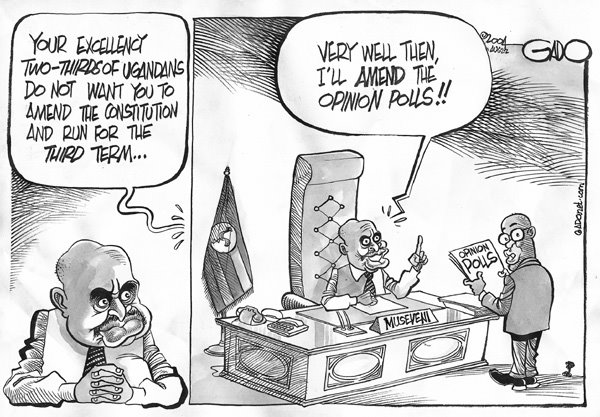
The once respected freedom fighter President Robert Mugabe did it in 2002 to Zimbabwe’s opposition leader Morgan Tsvangirai, now Yoweri Museveni, President of Uganda is doing it to his main challenger, Colonel (retired) Dr. Kizza Besigye. The arrest of Besigye in Kampala on Monday on questionable charges of treason and rape puts almost 20 years of progress and stability in Uganda under question. Besigye had just returned to Uganda from exile in South Africa in preparation for the March 2006 presidential elections.
What makes this latest African spectacle such a tragedy is that Uganda seemed to be a potential African success story. Uganda was once synonymous with violence, chaos and Idi Amin Dada’s predilections for human flesh. But since 1986 when Museveni and his rag-tag band of guerrilla fighters took over Kampala, there was hope. Museveni promised to bring political stability, economic growth, and good political leadership to Uganda. And he did for many years.
He introduced grassroots participation through Local Councils and a “no-party” political system. Past instability in Uganda was linked to politicized ethnicity argued Museveni, so if Ugandans could focus on the individual merits of candidates rather than their political party or ethnic, religious or regional affiliation, Ugandans might be able to focus on their similarities rather than their differences. Ugandans, fearful of a return to chaos, agreed to give it a try.
In June 2005 Ugandans voted in a referendum to adopt a multiparty political system rather than retain the no-party political system of government they had for the past 19 years. Museveni was able to change the constitution to allow him to run for a third term in the March 2006 Presidential elections.
While Western governments and the donor community were uneasy about Museveni’s questionable dedication to multi-party democracy Museveni’s economic successes and embrace of macro-economic reform helped assuage some of those concerns. Uganda under Museveni had one of the fastest growing economies in Sub-Saharan Africa. It had opened up its markets to international investment, and was willing to implement stringent structural adjustment programs. Museveni became a poster child of economic reform, receiving millions of dollars in foreign aid, and 100 percent debt relief from the International Monetary Fund, the World Bank and the African Development Bank.
Museveni was viewed as a new breed of African leader – a visionary -- one of the African Renaissance leaders. He was intelligent, savvy, beyond corruption (although it was doubtful that those surrounding him were) and dedicated to his people.
Of course, not everything has been so encouraging in Uganda. The Ugandan army has been fighting a northern insurgency since 1986, currently led by Joseph Kony, the fanatical leader of the Lord’s Resistance Army. Uganda’s imagine was tarnished by its military involvement in the Democratic Republic of Congo. And, most disturbingly, Human Rights Watch, an internationally respected non-governmental organization, published a 76 page report documenting widespread torture of political opposition members in Uganda.
So, what happened? How did the “darling of the West” start sliding down the slippery slope of authoritarianism? Did power simply become too intoxicating? Museveni and his supporters became convinced that no one could run Uganda as well as he could. A familiar argument made by many former self-appointed “Presidents for life”. Museveni is not an anomaly: The number of African leaders that have peacefully stepped down from power can be counted on one hand: Jerry Rawlings in Ghana, Julius Nyerere in Tanzania, Daniel Arap Moi in Kenya, and of course Nelson Mandela in South Africa.
Unless Museveni allows Besigye to run for President and lets the democratic process and rule of law determine who should be Uganda’s next president, Uganda may join the ranks of some of the current African trouble spots including, the Democratic Republic of Congo, Sudan, Somalia, Ethiopia, Cote D’Ivoire, Tanzania, and Zimbabwe.
The international community must demand that Museveni uphold the rule of law in Uganda. Donors should cut off aid to the Museveni regime, and the African Union should strongly rebuke Museveni. But most importantly, Ugandans must peacefully demand justice and democracy. The world is watching, and hoping desperately for another African success story in a country that Sir Winston Churchill once called the “Pearl of Africa”.
By Susan Dicklitch
Monday, November 14, 2005
Darfur: Whose Responsibility?
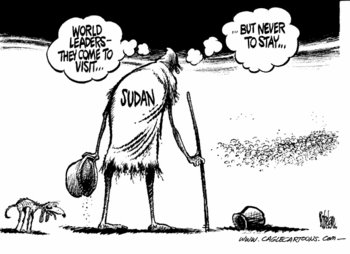 Darfur Sudan. Many Americans don't even know where that is. For many in Darfur, it is hell on earth. An estimated 2.6 million people have been effected by mass killings, torture, rape, the destruction of villages, theft and other human rights abuses. After the Holocaust the world said "never again". After the genocide in the former Yugoslavia, the world said "never again" And after Rwanda, the world said, "it depends". Well, I guess that's where the people of Darfur are. The United States has recognized that what is going on in Darfur is a genocide. It has been going on since February 2003. Why is it still going on? Two guest bloggers below, Nana K., and Thomas T., offer their views...
Sudan Is our Problem
By Nana K. (Okomfo Anokye)
Sudan an Eastern African country gained its independence in 1956. War has raged in Sudan for at least 38 out of its 49 years of independence. The most recent round of fighting has been going on since 1989. Since February 2003, the war has assumed a new dimension. In Darfur, a region of Western Sudan, over 180,000 people have been killed and over 1.8million people have been displaced (http://amnesty.org/). What is going on in Sudan today is a modern-day form of genocide. The government in Khartoum, Sudan is supporting the oppression and the killing of Sudanese nationals in order to maintain its reign. The global community with America as a hegemony has done nothing to help end the crisis.
A casual observer might ask the following questions. Who cares about some war in Africa? Has America not involved itself in too many conflicts? Are our soldiers not being killed overseas? As we live in constant danger of terrorism, should we not worry about our own welfare first? Engaging in foreign wars is killing our economy? If those “primitive” Africans are stupid to fight among themselves and killing each other, is that our problem?
Despite these concerns and fears and contrary to what we want to believe, Darfur is our problem. The critics will say “that is the most ridiculous thing we have ever heard”. Unfortunately it is not a ridiculous assertion. Darfur is our problem because we have a social-moral obligation under the Geneva Convention, through our US foreign policy we have supported and funded the warring factions, and our socio-economic well-being at risk.
The United States is a signatory to the 1948 Genocide Convention therefore; the US has a moral responsibility to fight against all acts of genocide. In Article 1 of the convention, it states clearly that genocide is a crime under international law and that all signatories will prevent and punish it.1 Clearly, under the convention, we are obligated to put an end to any inhumane acts regardless of the racial or ethnic identities of the group being oppressed. Under the 1949 Geneva Convention Common, Articles 3 and 147, all governments of the world are obliged to bring to book any perpetuators of inhuman treatment.2 The United States and the World as a whole have failed to live up to our responsibilities to safe-guard the rights of the people of Darfur.
So what? Who cares? Are we the only ones who have failed? Why does the world want to pin the problem of Darfur on the United States?
The US regretful to say has played a much larger role in maintaining and sustaining the genocide. The US government has indirectly funded the Khartoum government’s war. Between 1998 and 1999, the United States gave the Sudanese government $42 million in development assistance.3 In 2001, the United States also gave Sudan $27 million dollars in aid.4 No matter how altruistic the US government’s intention was, it is a widely accepted fact that that foreign aid is not always used for its intended purposes.
So why did we and do we still give Sudan aid? Well, one of the reasons is that Sudan is our ally against terrorism. In 1996, Sudan expelled Osama Bin Laden and they even wanted to hand him over to the Clinton administration, but we declined because of lack of indictable evidence.5 In President’s Bush’s September 20th speech, he was quoted as saying “Terrorists want to overthrow exiting governments in Muslim countries such as Egypt, Saudi Arabia.etc. They want to drive out Israel out of the Middle East. They want to drive Christians and Jews out of vast regions of Asia and Africa. America therefore should support its allies with security assistance”. 6 Aside from funding the government, the US has been supporting the other rebel movements in the south icluding the Sudanese Peoples Liberation Army (SPLM). The United States package to help the SPLM can be found in the House of Representatives legislature known as the Sudan Peace Act. Under the Legislature, the US government pledges to provide $10 million dollars in assistance to Sudanese opposition forces.7 The Christian Right is also placing tremendous pressure on the US government to support Christian groups like the SPLM/SPLA that are being threatened by Islam.8 Supporting the opposition will not stop the war, it will rather give them less incentive to end their armed struggled. Moreover, the SPLM soldiers are not saints, they have committed atrocities in Sudan including killing, looting and raping. Instead of curtailing the war, the United States is feeding it.
Though the problem in Darfur is geographically isolated from the United States, the effect that the repercussions of the war has on the US is greater than we want to accept. The United States imports approximately 17% of its from sub-Saharan Africa.9 Due to the crisis in the Middle East, the United States is focusing on Africa as its primary source of its oil. The Sudanese oil fields pump out at least $500 million a year. According to recent media reports Sudan will soon raise its oil output to 500,000 barrels per day.10 Since the US economy is negatively affected by oil shocks, it is in the best interest to stabilize its oil sources including Sudan to prevent any further mishaps to the fragile economy.
The refugees running from Sudan are also becoming burdens to the countries in which they are seeking asylum. These countries that have young developing economies like Ghana cannot sustain the pressure being induced upon them by the refuges. If these young economies are not safeguarded, they will collapse and the countries will be back begging at the feet of America.
In terms of terrorism, the Khartoum government is putting the whole world at risk. It is inculcating into the minds of young Sudanese that the war in Darfur is a holy war against the infidels. The government is therefore brainwashing these kids to join an unfounded Jihad. When the war in Sudan comes to an end what is our assurance that these brainwashed kids would not traverse the globe to implement their unfounded Jihad of the sword.
Contrary to what many politicians and social commentators would like you to believe Darfur is indeed an American problem. The United Sates can no longer afford to be apathetic or passive about what is going on in Western Sudan. We have meddled too much in Sudanese politics to extent that we cannot just pack up and leave. In concert with the global community we must work to find a long-lasting solution to the crisis.
Notes:
1The United Nations Text of Convention on Prevention and Punishment of the Crime of Genocide.
2 The Geneva Convention of 1949.
3Aid at a Glance for Recipient Countries and Territories Index of Charts “The Development Assistance Committee (DAC), the Organization for Economic Co-operation and Development (OCED) Aid recipient chart.
4 US Agency for International Development.
5 Sudan’s Perfect War by Randolph Martin http: //www.foreignaffairs.org.
6 Stop Subsidizing Terrorism by Brett Schaefer http:// www.heritage.org.
7 Sudan’s Perfect War by Randolph Martin http;//www.foreignaffairs.org.
8The Christian Right and American Foreign Policy by William Martin, Sudan’s Perfect War by Randolph Martin http;//www.foreignaffairs.org.
9Africa’s Oil Boom and the Poor by Ian Gray.
10Sudan to Raise Oil Output to 500,000 :-the New Vision.
Genocide IS Our Problem
By Thomas T.
The Convention on the Prevention and Punishment of the Crime of Genocide calls genocide “a crime under international law which [member countries] undertake to prevent and to punish.”[1] Because the United States has committed to preventing and stopping genocide by joining this Convention, it must act when it recognizes that genocide is occurring. The United States has made a promise to the world. In 1994, a 100-day genocide in Rwanda cost the lives of more than 800,000 people, as the world sat idly by. The international community had blood on its hands, and we resolved to prevent it from happening again. It’s happening again in Darfur. Because Secretary of State Colin Powell and President Bush have labeled the actions in Darfur as genocide,[2] we are legally entitled and morally obligated to do something to stop it. If we break these promises, we will be partially responsible for the deaths of hundreds of thousands of innocent civilians.
In order to understand why we have been weak in stopping the genocide, we must understand the government’s reason for non-intervention. The United States government believes it has strategic interest to not intervene with the genocide in Darfur, because it fears losing an ally in the War on Terror.[3] The administration continues to believe that another ally is more important than innocent peoples’ lives.
Now call me old fashioned, but I still believe that the strategic interest with Sudan cannot justify any inaction in the prevention of the deaths of hundreds of thousands of innocent people a year. While we must work to make sure that Sudan continues to help us on the War on Terror, we cannot simply ignore the genocide in order to do so. If we choose to ignore the plight of the Darfuri people because of our interests, we would be condemning the Darfuris to a world of pain and death. We would be assisting in the rape and murder of innocent civilians. And how again are we supposed to be morally superior to Al Qaeda?
The violence is not over, and the killings will not stop without international dedication. Just last week there were reports of 1,500 men attacking six villages in Darfur. Two million people still cannot or have not returned to their homes due to the fear of continued attacks.[4] The Darfuri people live in terror, and we cannot abandon them. Morally, how could it even be possible that we even consider breaking our promise to stop the violence that continues to occur to the Darfuris like we did to the Rwandans?
Some opponents to intervention legitimately argue that we do not want to send any more American troops to any more conflicts. Now, I agree that because of our country’s current situation, we do not want to lose any more American troops than we have already. Sending in Americans would likely cause more problems than it would solve, especially because the Arab World would likely describe the American intervention as another imperialist attack on a Muslim country (while ignoring the fact that the Darfur refugees are mostly Muslim). The African Union, however, has been willing to do the job. African countries have decided to send their own troops to stabilize the country, but they lack the resources to do their job to the best of their ability. Even though they have insufficient numbers, are inadequately equipped, and suffer from a weak mandate, they have been reasonably successful in deterring theft, rape, and other types of violence by their presence.[5] While attacks like the ones last week still occur, they have decreased in frequency (but are still at high enough levels to terrify refugees). Imagine, though, what the African Union could do if they had the resources that they needed.
The United States can easily provide the African Union soldiers with what they need, without ruining its relations with the Sudanese government. In fact, the United States and the international community have been calling for more action and larger numbers from the African Union. An international call against Sudan has already been made, and all we would be doing is putting our money where our mouth is. This would not likely harm relations between Washington and Khartoum intolerably.
By helping fund the peacekeepers at a cost of less than three hundred million dollars a year (a miniscule amount when compared to other United States government projects), the United States could help the African Union have phones in its offices, fuel for its vehicles, and money to pay the salaries of its soldiers.[6][7] In the words of an AU official, “The international community, UN, European Union and NATO can't ask us to increase our force in Darfur and then not come up with the money.”[8] We have the means to cutting down and ending the violence. We do not need to use our own soldiers, but rather to monetarily support those that are already there. How could we morally refuse do this? There is no reasonable excuse. We already have Rwandan blood on our hands. Do we really want to add Darfuri blood to the mix?
[1] “Convention on the Prevention and Punishment of the Crime of Genocide” <http://www.law-ref.org/GENOCIDE/index.html> Nov. 11, 2005
[2] “Powell Calls Sudan Killings Genocide” Sept. 9, 2004 <http://www.cnn.com/2004/WORLD/africa/09/09/sudan.powell/> Nov. 11, 2005
[3] Ooldenberg, Susan. “Sudan Becomes US Ally in ‘War on Terror’” April 30, 2005 <http://www.guardian.co.uk/usa/story/0,12271,1473788,00.html> Nov. 11, 2005
[4] “Sudan: Killings Reported in South Darfur, says UN” Nov. 11, 2005 <http://www.alertnet.org/thenews/newsdesk/IRIN/b2ceb1ad579a9759febf5e197941f268.htm> Nov. 11, 2005
[5] O’Neill, William G. and Cassis, Violette. “Protecting Two Million Internally Displaced: The Successes and Shortcomings of the African Union in Darfur” The Brookings Institution. <http://www.brookings.edu/fp/projects/idp/200511_au_darfur.pdf> Nov. 11, 2005.
[6] Blog entry from an aid worker in Darfur. July 27, 2005. <http://sleeplessinsudan.blogspot.com/2005/07/its-back-to-khartoum-this-morning-and.html> Nov. 11, 2005.
[7] “SUDAN: African Union short of funds for Darfur mission” Aug. 18, 2005. <http://www.irinnews.org/print.asp?ReportID=48634> Nov. 11, 2005.
[8] “SUDAN: African Union short of funds for Darfur mission” Aug. 18, 2005. <http://www.irinnews.org/print.asp?ReportID=48634> Nov. 11, 2005.
Monday, November 07, 2005
Is Genocide Uniquely African?
From 600,000 to 1 million souls slaughtered in just 100 days in Rwanda. Thousands killed, raped and mutilated in Darfur, Sudan. On-going civil war and instability in the Democratic Republic of Congo (DRC), Somalia, Cote D'Ivoire, Northern Uganda .... is violence and genocide unique to the African continent? Why does it persist? Below, our 2 guest bloggers this week, Sarah G., and Kennan J present their views.
Dr. D.
Sarah G.
There will always be genocide in Africa as long as "tribalism" exists...
"There will be no rescue, no intervention for us. We can only save ourselves. Many of you know influential people abroad, you must call these people. You must tell them what will happen to us... say goodbye. But when you say goodbye, say it as if you are reaching through the phone and holding their hand. Let them know that if they let go of that hand, you will die." -Paul Rusesabagina, Hotel Rwanda. The atrocities of the Rwandan genocide certainly turned heads around the world. In only three months, an estimated 800,000 Tutsis and moderate Hutus were slaughtered in the hands of the Hutu extremist group known as the Interahamwe. On the surface, this massacre appears to be the result of tribalism. However, this is a common misconception as the Rwandan genocide was not the result of tribalism but rather of lingering ideals and policies implemented during colonialism furthered by deficient government and economic disparity. This theory serves as a microcosm of the situation throughout Africa.
Unfortunately, the term "tribalism" usually carries a negative connotation in which society is divided into a myriad of small groups prone to hostility and violence towards one another. While enmity does exist within tribalism, it is often the product of invariable factors such as scare resources and corrupt governance. In fact, it is arguable whether or not the degree of brutality within tribal societies overshadows that of civilized societies. African tribalism parallels the theory of ethnocentricity in the sense that the disparity between in each tribe is the same by which we can all be culturally defined. In other words, the religious, linguistic, and cultural lines that identify a Tutsi or Hutu are no more than what makes someone an Irish Catholic American. In the same ways that large populations have grouped together to form states and nations, so have small ones to form tribes, and in this way is tribalism no more than a sub category of social evolution. Who is to say then, that existence of tribalism cannot be a peaceful one? If tribes of Chinese, Japanese, Italians, and Indians can all make rest in New York City, than why not in Africa? The answer to this question does not point towards flaws in tribalism but rather the faults of colonialism.
The recent situation in Rwanda serves perfectly to link colonialism to genocide. German and Belgian rulers brought with them to Rwanda pre-conceived notions of racial hierarchy and white supremacy. The kindness and elegance of Tutsi tribe, coupled with their European-like features greatly impressed them as they implemented a system of indirect rule. In this case, not only did colonialism create tribal divisions but it also fostered a sense of primacy between the Tutsi and Hutu tribes, which led the Tutsi's oppression of the Hutu erupting in the 1994 genocide. "When people ask me, good listeners, why do I hate all the Tutsi, I say, "Read our history." The Tutsi were collaborators for the Belgian colonists, they stole our Hutu land, they whipped us. Now they have come back, these Tutsi rebels. They are cockroaches. They are murderers. Rwanda is our Hutu land. We are the majority. They are a minority of traitors and invaders. We will squash the infestation. We will wipe out the RPF rebels. This is RTLM, Hutu power radio. Stay alert. Watch your neighbours" -George Rutaganda, Hotel Rwanda.
While direct rule may not always be the case as it was in Rwanda, the effects of colonialism and their pertinent link to genocide are numerous and widespread. In his book How Europe Underdeveloped Africa, Walter Rodney examines the way in which European nations economically exploited African resources, creating monocultures that divested national economies. Post-colonial theorist Franz Fanon investigated the psychological effects of colonialism, arguing that years of domination and subjugation led to an overwhelming sense on inferiority and inadequacy, which in turn barred nation's growth following independence. European nation's cherry-picked Africa's wealth, squandering her resources, demoralizing her people, and causing nations to fall into a pattern of dependency. Following independence nations were abruptly forced to fend for themselves. Economically and socially they were weak and divided and politically they were inexperienced and the continent became poverty stricken and politically corrupt. It was this that paved the way for coup d'etats and genocide.
All in all, African tribes do not innately lean toward genocide, but rather has colonialism influenced and instigated them. The peaceful existence of tribes in Africa is completely plausible, but it has been hindered by colonialism's numerous long-lasting effects.
Helpful Links:
http://www.globalissues.org/Geopolitics/Africa/Intro.asp#TheLegacyofEuropeanColonialism
http://www.foreignaffairs.org/20010501fareviewessay4773/jeffrey-herbst/the-unanswered-question-attempting-to-explain-the-rwandan-genocide.html?mode=print
http://floydn.blogspot.com/2005/09/societal-tribalism-in-south-africa.html
Monday, October 31, 2005
NEPAD (New Partnership for African Development) is a Sham

The New Partnership for African Development (NEPAD) came into existence in 2001. It is purportedly a new partnership between African countries and the West in an attempt to bring Africa out of its steady decline. Will it work, or will it be another African-led disappointment? Our 2 guest bloggers this week, Roz D, and Paradon M, offer their perspectives below. Dr. D.
When we take a look at the New Partnership for Africa’s Development (NEPAD), established in July 2001 by the Organisation of African Unity (OAU) and accepted by the G8 Summit of 2002 at Kananaskis, Alberta, Canada, we already see the failings of another to-be failed endeavor. An endeavor spearheaded by only five head of states at the time and supported by Western money and institutions, both private and government acting. Like much of Africa’s constitutions throughout the continent, the goals and wording are visionary in nature, with flowery language and phrases of idealism such as “good governance as a basic requirement for peace, security, and sustainable political and socio-economic development (www.nepad.org),” but are highly improbable to achieve in reality, at least for the time being. What is addressed below is not that African countries do not appreciate outside help from various countries and organizations…it is that many African leaders are blind to their actual countries needs, blinded by the Western education, blinded by an idealism that is hardly based in reality. Of course, African leaders try to legitimize their political, economic, and social reforms under the heading of OAU, NEPAD, or even the UN. What are needed instead are truly African organizations, based in realistic goals, with greater autonomy from Western influence, via money or Western policy-making dictating this or that over the other. What are needed are organizations that are not a sham.
Too often there are program initiatives that are brainstormed, produced, and implemented by legitimate organizations, in this case the NEPAD. What organizations such as NEPAD fail to recognize is that “fixes,” if you can even call them that, expect too much in too little time. We are not talking about the three to five year terms of projects that often get started. What is needed are truly long-term projects lasting at least ten years, preferably fifteen years as a median term for change. That is not to say that because now there is more time that more “goals” can be established; it goes against the whole idea. For example, on www.nepad.org website, there is a heading titled What are the immediate desired outcomes of NEPAD? with “conflict prevention and the establishment of enduring peace on the continent” and the adoption and implementing “principles of democracy and good political economic and corporate governance, and the protection of human rights.” One thing to say about those goals: ARE YOU KIDDING ME???!!! Those are immediate goals? What is your long-term goal: world peace? The remarks are not meant to be cynical. It is just that when one’s “immediate desired outcomes” are those goals that are still continually fought everyday in even developed countries, one has to wonder if NEPAD is living in a fantasy world. One has to keep in mind that many African countries are lead by corruption and the cult of personality, some would say a legacy from the colonial age. Instead, NEPAD, if it is truly going to be effective, must tone down its immediate goals and focus and work locally with respective African nations in establishing the basics such as food, shelter, and education. Although this is a simple statement with many caveats, essentially once you have a country with an educated populace that has enough food and shelter, a governance structure and along with it, rule of law, will begin to emerge.
To establish a credible and legitimate governance within a country, what is needed are not necessarily Western forms of thinking and governance. Instead, what is need are respective African country versions of governance. Too often, Western nations hope to influence how a country develops and “grows up.” They do so by using money as the carrot. That is, basically saying that if you want our money to develop your country, you are going to have to develop according to our terms and conditions. Already, the NEPAD is mired in Western bureaucratic mess. Even the leaders of the respective countries in the NEPAD think like Westerners. What many African leaders and most Western leaders fail to recognize is that problems within a country are not necessarily just internal but also inter-state conflict. For example, that is a “civil war” in the Congo has already involved individuals from eight countries. Even more, the NEPAD must distance itself from organizations like the G8. Yes, those countries mean well but they do not understand how to help. It is like asking a car mechanic to fix a plumbing issue in a house: yes, the car mechanic wants to help and does so but does not quite understand the intricacies and needs of the plumbing system as a fully certified plumber would. To allow for greater autonomy, the NEPAD must take a stand. NEPAD must demand to those nations willing to offer help that, “We welcome your money but we’ll fix our own way. What works in Senegal does not necessarily work in Sierra Leone.”
Lastly, there is a lack in the perception of historical success among many African nations. There is the thinking that nations can be restored to their “former glory.” To be honest: there NEVER was a former glory for many African nations. Instead, most African nations are experiencing success, or at least attempts for it, on their own and for the first time. As such, there are no leaders, including those from NEPAD, that can truly say that what they are doing has been tried and tested and works. Whoever says that is lying. How does one person, how does one organization know the key to success? They do not. It takes a group of people, the citizens of a country to make success happens. Yes, an individual can prompt a reform…but it is the citizens that want to carry it out.
In the end, NEPAD, for all its talk is a sham. It needs to realize that its goals need to be more realistic and/or increase the number of years. It needs to realize that Western influence and policies do not work for every single country. Finally, it needs to realize that what they are attempting to do has never been done before and to take baby steps.
Paradon M.
NEPAD: Africa’s Pursuit of Successful Destiny
By: Rosalyn D.
Now only four years old, NEPAD (New Partnership for Africa’s Development) has become an integral part of Africa’s progress made towards economic growth. The start of a millennium signaled Africa to take charge of their destiny, and pursue a new ambitious goal towards economic development. The continent saw a need to design an alternative strategy to the PRSPs (Poverty Reduction Strategy Papers) in order to confront its challenges of rising poverty levels, continual underdevelopment, and marginalization of its markets within the global economy. Hence, in July of 2001, NEPAD was adopted by the African Union.
NEPAD specified major areas of particular development assistance, including urgent debt relief; significant resources for infrastructure development; sustained financial outlays so that Africa can meet the United Nations millennium development goals of halving poverty rates by 2015; and, the end of trade distortions and agricultural subsidies by rich nations so that Africa can trade its way out of poverty through better access to lucrative Western markets.
Largely influenced by Thabo Mbeki and his idea of ‘African Renaissance,’ the institutionalization of key NEPAD principles are based on the idea that African dependence on aid and foreign intervention is a major barrier to African success. The main NEPAD principles and components are: African ownership and responsibility for
the continent’s development; the promotion and advancement of democracy, human
rights, good governance and accountable leadership; self-reliant development to
reduce dependency on aid; building capacity in African institutions; promoting intra-
Africa trade and investment; accelerating regional economic integration; advancing
women; strengthening Africa’s voice in international forums; and forging
partnerships with African civil society, the private sector, other African countries and
the international community. The efficiency of the program is characterized by executing these principles.
Endorsed by the G8, the NEPAD policies and priorities have become the internationally approved framework for Africa’s development. The APRM, African Peer Review Mechanism, has been largely successful. This peer review system has helped to establish camaraderie among the fifty-three nations, creating a forum in which each country is accountable for one another.
NEPAD has helped spread democracy and improve financial conditions. For example, in Mozambique, the world has observed peaceful changes of leadership for the first time. Also, since the implementation of the program, the average economic growth rate of Africa has increased from 2.9 in 2002 to 5.1 in 2004.
Copying is said to be the sincerest form of flattery. The NEPAD ‘Fight Against Aids’ campaign is a plan that addresses the impact of HIV and AIDS in Africa through integrated health sectors and new training techniques. This African program has been so successful in achieving positive results that other countries around the world have implemented the NEPAD Health Strategy.
Also, improvements and innovations have been made within the field of education. NEPAD has helped endorsed African partnerships through distance education learning, and exchange programs among African nations. These programs are geared for students interested in pursuing teaching, and focus on training and development.
The examples mentioned are a few of the many NEPAD successes. Clearly, the success of this program has helped to uplift Africa’s civil society. NEPAD has curt-tailed development within Africa, and has built the platform for all of Africa’s socio-economic success.
NEPAD is actualizing the AU vision of an Africa integrated, prosperous and peaceful, an Africa driven by its own citizens, a dynamic force in the global arena.
Ultimately, only time will tell how successful NEPAD will be in achieving economic development of Africa. However, the monumental progress made in just the first four years is quite notable. The initiative undertaken by the NEPAD plan is the first time Africa has banned together and taken charge of their plight. Taking charge means being held accountable for the issues that have continually plagued Africa, These include resolution of conflicts, poverty reduction, fighting corruption, eliminating the burden of disease and strengthening the capacities of African states. Arguably, the most important aspect of NEPAD is its initiative to facilitate the idea of African ownership of development issues. Unlike other development programs that have come and gone, NEPAD was created by Africans for Africans, ensuring the sustainability of success in the future.
Works Cited:
Coleman, Sarah. “ The NEPAD Formula” [Online] World Press Review. http://www.worldpress.org/Africa/578.cfm. 27 October 2005.
NEPAD – The New Partnership for Africa’s Development (October 2001), 57 pp. e-disk
“NEPAD” [online] Wikipedia, the free encyclopedia. http://en.wikipedia.org/wiki/nepad. 27 October 2005.
“Nepad, the AU and the EU: the challenges of a relationship” European Union: Delegation of the European Union Commission of South Africa. [Online] http://www.eusa.org.za/PDFdownload/Speeches/Lake_Nepad_AU_EU_2003.pdf. 27 October 2005.
Taylor, Ian (2004) “Why NEPAD and African Politics Don’t Mix”, Foreign Policy in Focus e-disk
Subscribe to:
Posts (Atom)
Featured Post
Turkey's Ban on Insults against Erdogan
Since 2005 Turkey has had a law against insults against Erdogan known as Article 299. The article declares that citizens can be imprisoned ...

-
 Great news! Now you can sit back in the comfort of your own home and actually see (provided you have access to high-speed internet) the phys...
 -
Who couldn’t agree with British Prime Minister Tony Blair and rock stars Bono and Geldolf that something has to be done about poverty and u...
-
From 600,000 to 1 million souls slaughtered in just 100 days in Rwanda. Thousands killed, raped and mutilated in Darfur, Sudan. On-going civ...

