Wednesday, August 19, 2020

Has Democracy Lost its Luster?


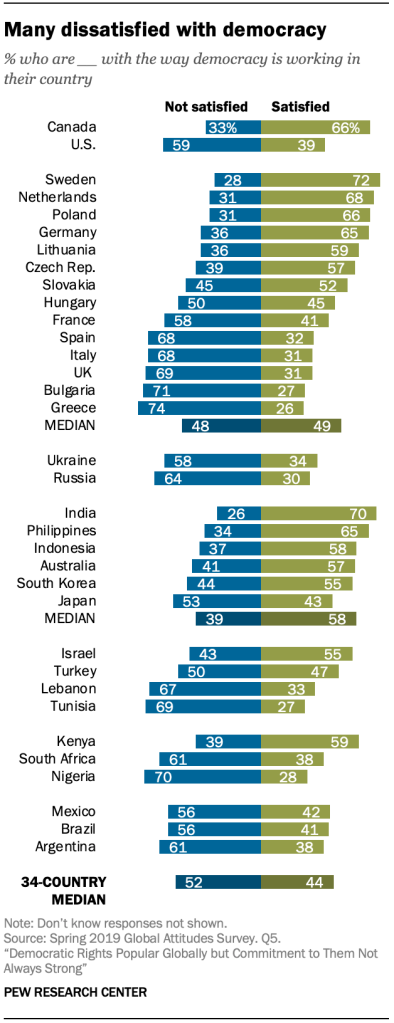
A recent pew research report suggests that many people in the world are not satisfied with their democracy. Has democracy lost its luster?  Poland, Hungary, Brazil, are interesting case studies. They have populist, conservative leaders at the helm, yet they have varied responses. The United States is a shocker. Or is it really?  Especially when compared to its northern neighbor, Canada. Why do you think that there is such varied dissatisfaction with democracy?

Source: Pew Research Center: https://www.pewresearch.org/fact-tank/2020/02/27/how-people-around-the-world-see-democracy-in-8-charts/   


Tuesday, January 05, 2010

The Canary in the Coalmine: Homosexuals in Uganda


Old miners used to send canaries into the coalmine to make sure that the mines were safe for the miners. If the canaries died -- the miners knew not to go into the mines. Homosexuals in Uganda are modern-day canaries in the coalmine -- and the government of Uganda is proposing to sentence them to life in prison for their homosexuality.

There is no such thing as "gay rights" in Uganda. For whatever reason, the Ugandan government has decided to one-up even the most homophobic leader in Africa: Robert Mugabe of Zimbabwe.
Uganda now shares the same limelight as other human rights abusive regimes such as Saudi Arabia and Egypt in its treatment of homosexuals.

Ugandans, like many other Africans, refuse to believe that homosexuality could possibly be indigenous to the country. Not only is it a sin against nature, but it is a colonial import.
The reality is, that homosexuals are human beings -- just like heterosexuals. Until Ugandans and others realize that, human rights will be mere rhetoric.
Photo credit: CNN

Sunday, March 22, 2009

South Africa: A Country of Contradictions


I recently returned from a 10-day intensive trip to Cape Town, South Africa. I was really excited because I had never traveled to South Africa before. I remember hearing and reading about Apartheid growing up, so I was eager to see how much progress had been made since the end of Apartheid in 1994.

A group of us from Franklin & Marshall College were going to see if we could set up a community-based learning program linked to our artificial soccer turf field in one of the largest and poorest townships in Cape Town, Khayelitsha. Having traveled throughout Sub-Saharan Africa in the past, I was prepared for poverty, and all the other issues that afflict developing countries. What I was not prepared for was the astounding contradictions and contrasts that make up 21st century South Africa.
Take the World Cup Soccer stadium for example. Or the impressive motorways and airport. The opulent restaurants and mansions hugging the rugged cliffs, making way to beautiful beaches. Beautiful beaches with beautiful people. After all, the New York Times Magazine just featured Cape Town as the place to be. What they didn't show was the other side of Cape Town. The side that people would like to ignore -- to pretend no longer exists with the end of apartheid.

That's the side that we focused on. The shacks of Khayelitsha where children still die from playing with live wires knocked over by oversized trucks -- or where women and children line up at boreholes to pump water for their daily meals. No bottles of "still or sparkling water" here. Here in Khayelitsha where the delicassay is "smilie" -- sheeps head -- not cavier -- although I personally don't know which is worse.

Cape Town is a place of hope and possibilities -- wealth and extravagence. Khayelitsha is a place where you are lucky if you are not shot and killed, or if you are a woman, raped and abused.
When you visit Cape Town and Khayelitsha, you have to exercise cognitive dissonance -- how else can you make sense of the two realities? I remember spending the better part of the afternoon walking through Khayelitsha (with protection from local residents of course) and then going for lunch at the waterfront in Cape Town. We strolled through a mall with Gucci stores, Tag Heur, and Channel. The latest colgnes and perfumes floated from the inviting stores. An hour earlier, we passed open air stalls with beef entrails, sheep's heads, and other animal body parts. The stores were pieced together scraps of corrugated iron and cardboard. Dried piss, charcoal and exhaust fumes scented our journey.

I still don't know what to make of my trip to Cape Town. It made me feel dirty inside. Not being in Khayelitsha -- but being in downtown Cape Town -- enjoying all the conveniences of home -- knowing that only a few miles away, people were struggling to stay alive. So if you go to Cape Town to enjoy the World Cup or some of the beautiful beaches and shops -- be sure to extend your visit to the townships -- that is of course, if you really want to see the real South Africa.
Wednesday, July 02, 2008

Mugabe leaves summit under pressure

At the end of our class session, we left on a defeating note that Mugabe has essentially won the one-man race in the election. However, it may be the case that Mugabe may be forced to leave; great distaste internationally has been expressed towards Mugabe's actions. This may be a hopeful and optimistic approach to the matter, but it seems that the people of Zimbabwe need just that.

The article summed up the actions of the AU meeting in Egypt. You can also see by the attached photo to the article, that Mugabe is clearly disturbed. This is a great contrast to the arrogance displayed when he won the election. Perhaps this could be a catalyst to ousting Mugabe and hopefully it is.

Wednesday, June 25, 2008

Franklin & Marshall team member uncovers missing link for elephants in Eritrea!

Here was that article I discussed earlier in class. It seems that Robert Walter of the Earth & Environment department here at Franklin & Marshall was very influential in the archaeological dig that uncovered the missing link between ancient and modern elephants. The animal is around the size of a modern day pig and provides substantial assistance to archaeologists in determining what route each species took as well as the evolutionary paths each animal took. It is also wonderful to see that Franklin & Marshall is making headlines, especially in such a young country as Eritrea.

Sunday, June 22, 2008

Little Hope for Zimbabwe

So Mugabe did it. He intimidated the opposition so much that they pulled out of the run-off election citing fear of violence against their supporters.
So now what?
Mugabe has been in power since 1980 -- if my math is right, that is 28 years. When is enough, enough?
It seems that Mugabe will soon be following the same steps as Mobut Sese Seko, the former dictator of Zaire -- now the Democratic Republic of Congo.
When does the "Big Man" rule end? How does it end? Is bloodshed always necessary? Outside intervention? What kind? The U.N.?
To say that I was surprised that Mugabe was able to retain power would be to lie.
What will surprise me, is if the rest of the world finally takes heed of what is going on in Zimbabwe and acts. Sanctions? The International Criminal Court? C.I.A., anyone?

Monday, June 09, 2008

Zimbawe Voters Threatened with Violence

This article very much builds on the last one posted, as it also deals with the June 27th election in Zimbabwe between incumbent President Robert Mugabe and opposition leader Morgan Tsvangirai, but his one deals with alleged acts of violence rather than just limits on food or attempts at starvation. Human Rights Watch, a New York based activism group has learned that President Mugabe and his party, Zanu-PF have been running torture camps for supporters of Tsvangirai's Movement for Democratic Change (MDC) party. The Human Rights Watch report lists many attacks, including 36 deaths at the hands of Mugabe's men.

Clearly this article continues to outline a recurring problem in Africa -- corrupt, bad governing and leadership. While almost universally considered to be largely responsible for Zimbabwe's economic crisis, including rampant inflation, unemployment, and the collapse of the agricultural sector, Mugabe has proved he will do absolutely anything to remain in power. He has illegally impeded his oppositions election, attempted to starve out his enemies, and now, even allegedly killed those who stood in his way as he continues to blame Zimbabwe's colonial history and the West for problems that he has perpetuated at best and caused at worst.

The problematic question becomes at what point does an outside agency take action? Revolutions seem to have to come from within to be successful, and outside forces can only do so much before the country has to run and remain functional on its own. The rights of Zimbabwe's citizens are being violated, but there is no obvious answer for how established nations should respond to this crisis, which makes it very difficult and very interesting.

Friday, June 06, 2008

Police stop Zimbabwe opposition leader's campaign

HARARE, Zimbabwe - Police briefly detained Zimbabwe's opposition presidential candidate Friday for the second time this week and told him the party's rallies had been banned indefinitely three weeks before the runoff election, an aide said.

Monday, June 02, 2008

Rwanda angry over Munyakazi being kept by ICTR

This article talks about the genocide in Rwanda in the 1990s, and how the ICTR (The International Criminal Tribunal for Rwanda) in Tanzania has refused to hand over possible war crimes and human rights violator Yussuf Munyakazi due to fear of him not being able to have a fair trial. Rwanda leader Tharcisse Karugarama has assured the media that the tribunal has made a mistake and that the trial would have been fair, and that Rwanda has a right to try criminals like Munyakazi for the crimes they committed in Rwanda. Estimates suggest 800,000 Tutsis and many moderate Hutus were killed during the genocide in 1994.

Questions about the fairness of Rwanda's judiciary system led Amnesty International to call on all governments not to extradite prisoners to Rwanda, where unfair pressure on the judiciary would prevent a fair trial. Karugarama assures that this isn't the case, and in recent years the Rwandan government has taken steps to allow more prisoners to be extradited to them, specifically abolishing the death penalty which has prevented many prisoners from being turned over to them.

I find this case to be very interesting because it features Amnesty International standing up for the rights of someone accused of genocide. It's taken for granted that you have the right to a fair trial in America, but it's still interesting to see a case where concern for the rights of someone most likely guilty is taken so seriously -- you'd think people wouldn't make much of a fuss about a guy like this. Regardless it seems like Rwanda is attempting to take the necessary steps to improve their government and judicial system, which is definitely positive and could help them try their own criminals like this in the future.

Wednesday, March 19, 2008

Franklin & Marshall College in South Africa

Hi Folks,
I just wanted to bring your attention to some incredible work that the F&M soccer team is doing in South Africa. The students are involved in Grassroots Soccer to help bring attention to HIV/AIDS in Khayelitsha, South Africa.

Featured Post

Turkey's Ban on Insults against Erdogan

 Since 2005 Turkey has had a law against insults against Erdogan known as Article 299. The article declares that citizens can be imprisoned ...