Thursday, September 17, 2020

Hong Kong: A Pro-Democracy Without the Freedom of Speech

    The people of Hong Kong find themselves with tape now permanently stuck to their mouths because of the recent passing of a new security law on June 30th. China claims that this new law will return stability to Hong Kong, but residents say that the new law forces them to stay quiet, and to no longer have the right of freedom of speech without worrying about facing punishment. The new security law gives mainland China jurisdiction to censor media, intervene in public affairs, extradite people who’ve escaped to Hong Kong for political sanctuary, and more. In simple terms, this means that the recent passing of China's new security law makes it easier to punish protests and reduce Hong Kong’s autonomy. This worries and scares the people of Hong Kong because they believe that with this new national security law, they have lost freedom of speech.  


Although Hong Kong is under China’s rule, and China is a “socialist democracy” which is really a system controlled under the Chinese Communist Party, Hong Kong is known for being pro-democracy and making the most out of their power to speak freely. Free speech in Hong Kong has played a role in international news media and rights groups. Even under China’s rule, Hong Kong clung onto an independence that allowed them to have material on political topics that was banned in mainland China, protest freely, and demonstrate a pro-democracy territory. However, with the passing of this new security law, limits have been placed where the people of Hong Kong feel like they longer have a voice. The police have arrested more than 20 people because of this new law, with the crimes being punishable up to life imprisonment and allowance for Beijing to directly intervene if they find if wanted.


Changes in Hong Kong have been visibly significant. The owners of a particular bubble tea shop (who had once supported the protests and the idea of pro-democracy) removed all signs of the support, posters, and signs that once was used as a form of decoration. Another example was a restaurant in Hong Kong that removed all supporting signs of the protest and replaced them with Mao-era propaganda posters. Finally, all publishers had to quickly rewrite various textbooks used in academic civic courses to avoid punishment, since the textbooks openly criticized the government. Libraries have also followed suit, where all books written by democracy activists have been removed.


Even with all of these changes, the limits of the new security law is “vaguely defined”, giving the people of Hong Kong the room to make risks seeing just how much they are now allowed to say, write, or tweet. Some individuals have brought creativity into this situation, carrying blank signs or signs with coded messages to continue to protest. They have also begun to play protest songs, but without the lyrics. But the police are giving the young protests warnings, telling them to watch out. Because as soon as they express any kind of criminal opinion, they will be punished and arrested because nothing can fight the law. 


Sources: 


https://www.nytimes.com/interactive/2020/09/04/world/asia/hong-kong-speech.html


https://www.bbc.com/news/world-asia-china-52765838


Wednesday, September 16, 2020

2020 Presidential Election: Do Political Advertisements need More Regulation?

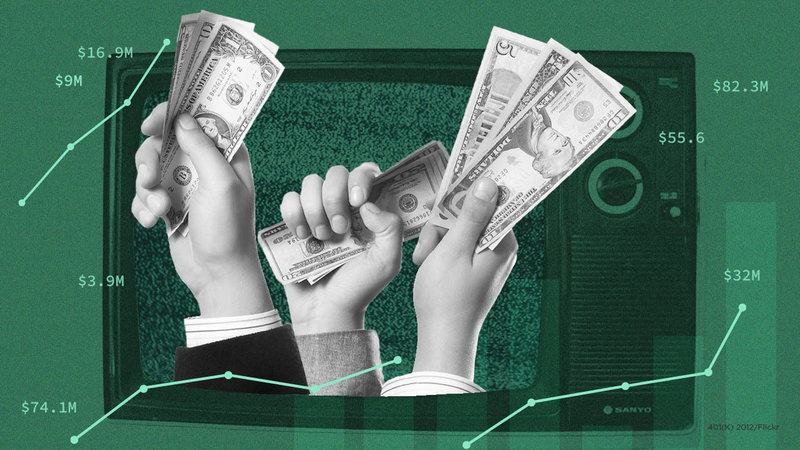
    Swings states are being targeted by presidential campaigns for the 2020 election. According to Advertisement Analytics, an ad tracking firm, the Trump campaign has spent $57.5 million and the Biden Campaign $63.7 million on advertisements. The presidential nominees are targeting swing states in this extremely close election. Florida has been fought over between Biden and Trump since July. Their advertisements include some misleading information about each other and have the ability to sway millions of people. President Trump has portrayed Joe Biden as somebody who wants to take away social security and give it to immigrants. In the advertisements that have aired on television in Florida, the Trump administration has made false claims about what Biden would do as president. Biden has portrayed President Trump as someone who talks a lot but has done very little for the economy or pandemic. Both campaigns have spent enormous amounts of money on political advertisements in Florida. They are targeting Florida because the race is expected to be closer than any other state. Florida television screens are being overflowed with political advertisements to influence the election as it has done in the past, but where does it end?


Caroline Amenabar/NPR https://www.npr.org/2020/09/15/912663101/biden-is-outspending-trump-on-tv-and-just-6-states-are-the-focus-of-the-campaign


    Political advertisements should be met with more regulation and fact-checking. There should be non-partisan fact-checking for all advertisements that are aired for political purposes. In Florida, more than $200 million has been spent by the Democratic and Republican nominees in advertisements. There needs to be more legislation monitoring the accuracy of political advertisements because they persuade many voters. Legislation will allow people to vote based on the facts of the two presidential candidates instead of the lies. 


Sources

  1. https://www.nytimes.com/2020/09/15/us/politics/trump-biden-ads-florida.html

  2. https://www.npr.org/2019/05/14/723215498/florida-governor-says-russian-hackers-breached-two-florida-counties-in-2016

  3. https://www.theguardian.com/us-news/2019/aug/27/florida-russian-hackers-target-2020-election

  4. https://www.cnn.com/2020/09/16/politics/biden-campaign-ad-spending/index.html

  5. https://www.bloomberg.com/news/articles/2020-09-14/trump-campaign-slashes-ad-spending-in-key-states-in-cash-crunch

  6. https://apnews.com/c8c65ca2021d4c7ec5542c5b9335600c

  7. https://www.npr.org/2020/09/15/912663101/biden-is-outspending-trump-on-tv-and-just-6-states-are-the-focus-of-the-campaign

Tuesday, September 15, 2020

Mindfulness: Do (social) democracies have a leg up in tackling a pandemic? And why do women keep winning?

 The stress of a pandemic can serve as a good, not an ideal, litmus test for the integrity of a government. Ideologically governments are thought of as the equilibrium of freedom and equality, but on the ground governments are responsible for a whole lot of damage control. At a first glance it may seem that authoritarian governments would have the advantage in the matter seeing as though not only do they have the advantage of unitary decision making and cultures that are comfortable with the almighty grip of a centralized government. As the Los Angeles Times op-ed suggests,  “Democracies are slow and chaotic. Autocracies are fast and coordinated.” But maybe speed is not the name of the game.  The diverse civil societies and checks and balances in a democracy are lending themselves to greater innovation and adaptability in these challenging times. Slow and steady wins the race. Additionally the nuances of a bipartisan or multiparty system hold leadership accountable and set a certain standard of transparency which in the haze of this pandemic has been sorely lacking in authoritarian governments.  

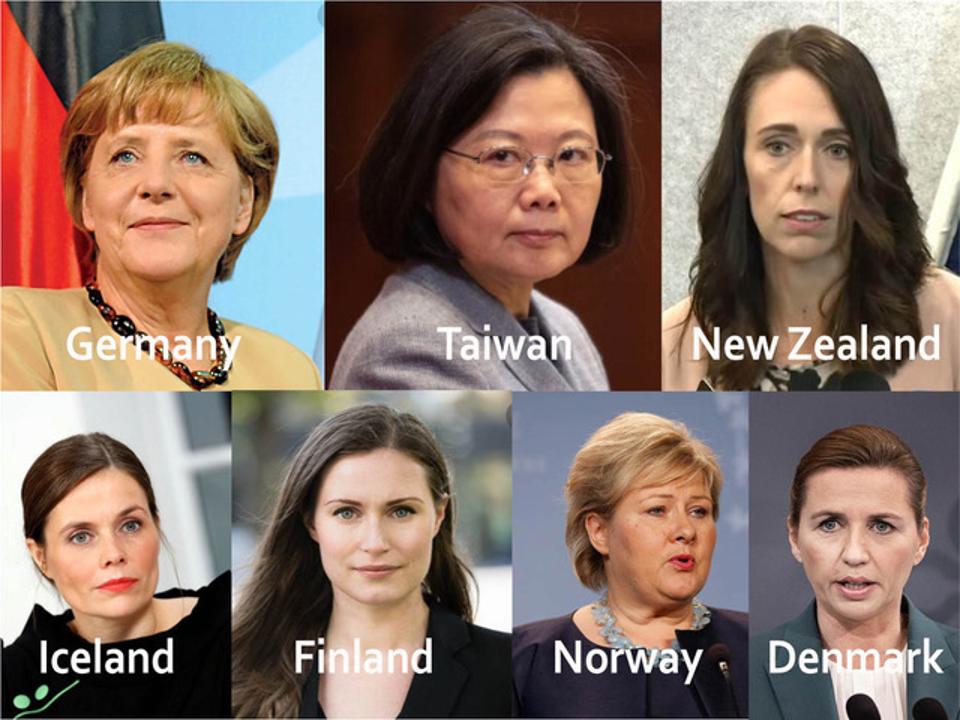
The article also nods towards the advantages of a social democracy in contrast to a liberal democracy in handling a pandemic. The welfare states of a social democracy often lead to further developed civil societies which play an important role in solving for emergencies. Furthermore there is a norm of respect for government in social democracies which leads to people being more compliant in measures to decelerating the spread (ex. voluntary contract chasing  in Taiwan). Another common denominator of these social democracies that have  seen great success is women in executive positions. As the popular Forbes article points out the majority countries that have best handled the pandemic have benefited from the leadership traits most present in women. But empathy and honesty are not traits uniquely or over present in women, but traits that are valued in the fabric of social democracies. The fact that there are these strong women executives beating a pandemic speaks to the themes of acceptance and progressiveness that would lead to the opportunity for a woman to be elected nevertheless on the ballot. Whether it be a yoga class or a sudden pandemic mindfulness seems to be the key in overcoming obstacles. It may be no surprise, but flexibility, time, and collaboration lead to the solutions and accountability that it takes to tackle something so unprecedented. 


Are Democracies Equipped to Handle Fast-moving economic crises?

     As democratic rivalries rise, the discrepancies and issues with democratic governments are recognized and magnified. Out of 91 democratic governments that surfaced from 1974-2012, 34 of those democracies have collapsed while the effectiveness of 28 other democracies has flatlined. With the rise of COVID, democratic governments take a big blow from social issues such as inequality among the population, discrimination toward minority groups, and systematic corruption. 

     Over the decades, many countries have fought against tyranny for the ideal democratic society that ensures freedom among the population. However, just as though there are many positives about a democratic government during a crisis, there are many flaws and disadvantages as well. The problem for democracies during a national pandemic is the question of whether the government should take the proper precautions to ensure the preservation of the community as a whole and strive to minimize COVID even it invokes the population's freedom or should the government focus on minimizing economic costs while setting guidelines that could benefit the society during the pandemic while allowing the freedom of the population to continue? One false decision could end the democracy if the pandemic freezes the economy by its uncontrollable increase in cases. 

    These decisions cause a polarization of what is the true function of a democratic government. Originally, a democratic government is supposed to be able to create a society where the population can exercise free speech, press, etc. However, during the crisis in Indonesia, a poll taken by the people before and during the crisis had shifted from those original views to the idea that a democratic government should instead provide great decision-making on behalf of the people instead of leaving the decision making up to the people. The issue of modern-day Indonesia is that this pandemic can lead to civil unrest, political turmoil, and an economic meltdown. Indonesia's informal sector of workers is taking the biggest economic impact of this crisis and this is very dangerous because this sector makes up the majority of the workforce. The Indonesian government has implemented fiscal policies that plan to fund and advance healthcare and provide economic assistance to poor communities. The problem is whether these policies are adequate enough to work and if a democratic government is a sustainable concept during a crisis. With rising uncertainty on whether the Indonesian government is capable of willing their people through this pandemic, the efficiency of a democratic government such as this will be tested.


Sources:

https://www.thejakartapost.com/academia/2020/09/08/insight-are-democracies-equipped-to-handle-fast-moving-economic-crises.html

https://www.icis.com/asian-chemical-connections/2020/05/southeast-asia-polyolefins-demand-may-fall-by-as-much-as-during-asian-financial-crisis/

https://www.bbc.com/news/world-asia-54034014


Thursday, September 10, 2020

Complications Arise with Brexit


    A recent legislation concerning Brexit going through Parliament by Boris Johnson has caused much uproar. Although Brexit was officially agreed upon on January 31st , 2020, this deal only established some essential elements of government, such as citizen rights and financial settlements. At the time of the agreement, one of the most significant points made was how Northern Ireland would be handled. This treaty eventually became known as the Northern Ireland Protocol, established how trade would operate in Northern Ireland, which allowed for checks and declaration of goods to be regulated in a similar fashion to the EU. However, Boris Johnson introduced legislation that would change and oppose some of the aspects of the Protocol in very specific ways. This new legislation has sparked numerous controversies, revolving around the issue of potentially breaking international law to lose of reputation. High officials in UK have also resigned due to the act, such as secretary to the Government Legal Department, Sir Jonathan Jones.

            What the legislation ultimately forces people to ask is how it will affect the overall Brexit transition. Trade negotiations with the EU are still ongoing, and further complications provided through legislation might make such talks stall out longer than they might have originally. Keep in mind that the UK only has until October 15th to reach a new trade deal with EU, otherwise there will be no deal at all. This would mean that tariffs and exports would severely suffer in profit for the nation as a whole and doesn’t even begin to discuss the potential issues arising from any trade deals with the United States. To make matters worse, other issues, such as immigration and security, haven’t even been fully and properly discussed yet. Further complicating economic matters only delays the conversation of social matters, potentially jeopardizing the democracy of the nation.   

Credit: European Commission (https://ec.europa.eu/info/publications/slides-used-m-barnier-occasion-presentation-commissions-proposal-council-recommendation-directives-negotiation-new-partnership-uk_en)

Sources:

https://www.bbc.com/news/uk-politics-32810887

https://www.bbc.com/news/uk-politics-54059946

https://www.bbc.com/news/uk-politics-54073836

https://www.cnn.com/2020/09/09/uk/boris-johnson-rule-of-law-brexit-intl-gbr/index.html

https://www.bbc.com/news/uk-politics-54097320


Wednesday, September 09, 2020

Taiwan Calls for a Democratic Coalition

China has been increasing military activity around Taiwan. This has come as an act of aggression towards the current President of Taiwan, Tsai Ing-wen (leader of the Democratic Progressive Party), to encourage respect for the relationship between the two territories. Based on an agreement made between China and Taiwan in 1992 Taiwan is under the “One China” principle, in which it was agreed upon that Taiwan would not seek its own independence. However, Tsai has rejected this agreement arguing that the system of “one country, two systems” was failing the Taiwanese people in 2019. Support for this idea is shown by the rise of Taiwanese identity independent of Chinese identity where it can be seen that the people are beginning to support this idea. In addition to the reelection of Tsai in 2020, the new generation in Taiwan seems to be pushing for independence and this is only the beginning. 

With the rising threat of China’s authoritarian leadership, Tsai is calling for support from other countries to help her fight for their democracy. She says she would like to maintain peace but needs the support of other countries in order to do so. So far only 15 countries have officially supported Taiwan as its own country independent of China. With the U.S. being Taiwan’s main defense provider there is pressure for them to take a stance. Although there are no formal diplomatic ties between the US and Taiwan, creating that relationship would be a hard stance against China and for democracy. Considering rising tensions between the US and China it will be interesting to see how this plays out and to see if Taiwan can gain the favor of world political figures. 

Credit: CFR Editorial. Source: Election Study Center, National Chengchi University.

Monday, September 07, 2020

Voters of Color Settling for Biden


 With the 2020 election right around the corner, voters find themselves in a tough place of not knowing who to vote for. Several members of the Democratic Party are struggling with the Democratic candidate, Joe Biden, just as much as our current President, Donald Trump. In an NPR interview, three individuals of color highlight their thoughts on our current situation as a nation, and their upcoming plans for the election.

On a scale of 1-10 the interviewees were asked to rate their enthusiasm about voting for Biden. Pastor Carl Day, an African American male, gave a 2-3. Parul Kumar, a student at the University of Chicago, said she was a 1-2, maybe 3 on a good day. Lastly, Adrienne Smith Walker, an African American female in her mid 40s, rated her enthusiasm for Biden a 0. The reasoning behind their given ratings differ but essentially they all feel that the given candidates are not fit for the job. They are concerned about the future of our country in either man's hands. Even with Kamala Harris as Biden's running mate, they feel that this is a push to gain the African American vote not feeling it is authentic or genuine. Pastor Carl Day said that the Biden/Harris campaign "reeks" yet he still leans toward the democratic side for his vote. 

What does our current political situation say about American democracy? If voters are left to settle with the two given candidates, there is an issue with America. Our country was built on freedoms that allowed us to vote for the best possible person, but maybe we don't have the best option right now. The two political parties we currently have differ greatly in political agendas, ideas, and presentation. Because the two parties have very little common ground, voters are left with an extreme decision that could lead to future failure. Perhaps a third party would ease political tension, bring compromise, and meet the needs and wants of the American people. 

Free Image by Tiffany Tertipes


Sunday, September 06, 2020

Do Americans care about the environmental issues going on right now in America?


Do Americans care about the environmental issues affecting their country right now?           Sammi Perry


    Overall, Americans do support protecting the environment but there are partisan divides on this issue. In a survey last year, they found that 74% of adults want the government to do whatever it takes to help the environment. This was compared with 23%, who said the country doesn’t need to put any more effort into the environment. Democrats lean toward saving the environment more than Republicans do. 


There also has been a big gap in support for environmental issues, that has increased to 38% between Republicans and Democrats. Now, 58% of Republicans say that the government spends too much on the environment that leads to hurting the economy and jobs. Even though 55% of Americans ranked environmental issues as a top policy issue, 76% of Americans believed in strengthening the economy and preventing terrorist attacks. Even only 1 in 5 people actively say they want to make an effort to protect the environment. There is even only 32% of people who say they are bothered by people who don’t recycle. Although, data does show that 46% of people actively try to recycle. There is always a spilt view on enviormental issues between both political parties.Overall, helping save the environment, in my mind, is a top priority because it lacked support in past years. 


News Article: https://www.pewresearch.org/fact-tank/2017/04/20/for-earth-day-heres-how-americans-view-environmental-issues/ 


Monday, August 31, 2020

Do Americans Care More About their Party than Democracy Itself?

    A new study out of Yale found that “only 3.5% of US voters would cast ballots against their preferred candidates as punishment for undemocratic behavior.” Such behaviors included gerrymandering, press restrictions, etc. Results did not vary for either party (Government Executive, 2020). This study implies that voters may be choosing their own party affiliation and values over democracy itself. Researchers noted this may have to do with political polarization, with each candidate becoming so separate each other, that the voter has too much to lose by not voting their party and votes them regardless of democratic values. 


    This makes us ask the question, do Americans still care about Democracy? Or is it now simply a two-party system that is putting party loyalty above any other values? Does this mean America could change from a Democracy to a new political system in the coming years if we remain on this trend? 


Sources

News article: https://www.govexec.com/management/2020/08/most-us-voters-value-party-over-democracy/167914/ 

Study #1: https://www.cambridge.org/core/journals/american-political-science-review/article/democracy-in-america-partisanship-polarization-and-the-robustness-of-support-for-democracy-in-the-united-states/C7C72745B1AD1FF9E363BBFBA9E18867


Wednesday, August 19, 2020

Has Democracy Lost its Luster?


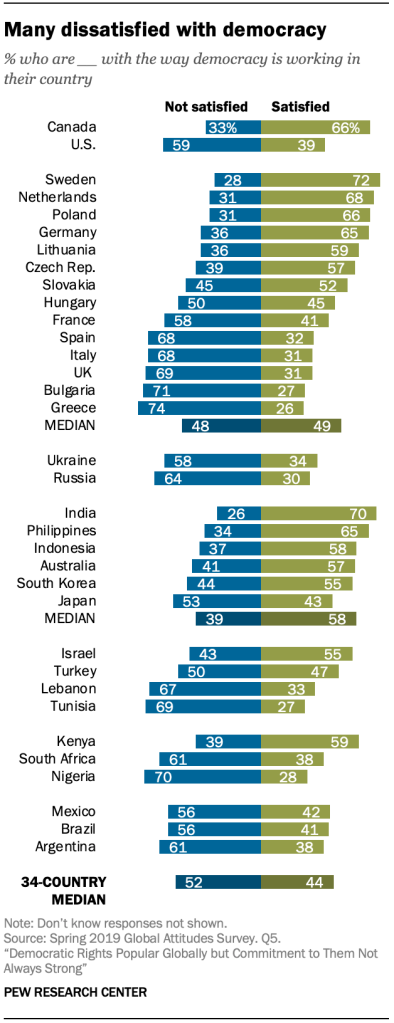
A recent pew research report suggests that many people in the world are not satisfied with their democracy. Has democracy lost its luster?  Poland, Hungary, Brazil, are interesting case studies. They have populist, conservative leaders at the helm, yet they have varied responses. The United States is a shocker. Or is it really?  Especially when compared to its northern neighbor, Canada. Why do you think that there is such varied dissatisfaction with democracy?

Source: Pew Research Center: https://www.pewresearch.org/fact-tank/2020/02/27/how-people-around-the-world-see-democracy-in-8-charts/   


Featured Post

Turkey's Ban on Insults against Erdogan

 Since 2005 Turkey has had a law against insults against Erdogan known as Article 299. The article declares that citizens can be imprisoned ...